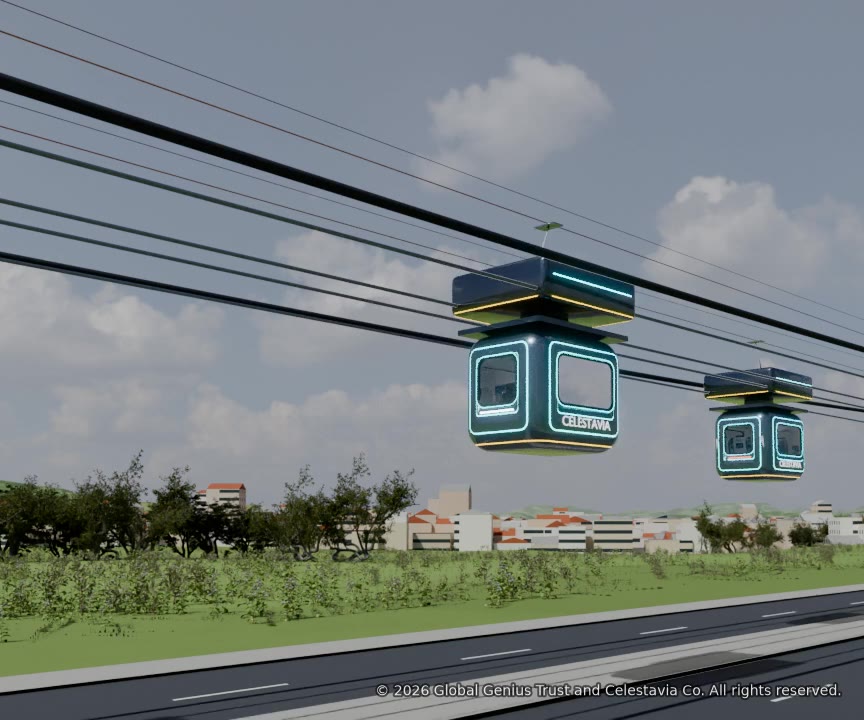
Elevated electric transport on fixed steel ropes
Celestavia's electric carriages drive along two large steel ropes per track: the carriage moves, not the rope. Passengers and cargo travel above floods, traffic and landslides, at up to 90 km/h.
Not a cable car. Not power lines. A new elevated transport network.
Who are you?
Choose and we adapt this page to you. You can change it at any time.
Transport for everyone, above the street
Celestavia is a new kind of public transport: cabins for 9 to 18 people and boxes for cargo, carried by electric carriages that drive on steel ropes from tower to tower. You book in the app or walk to a station near you, and travel above the traffic. Below: what it is, how it works, the videos, the benefits and the projects in your country.
Start hereFor governments: solve transport problems from above
Celestavia lines run above existing roads, rivers and forests on slim towers, so the land below stays in use. We simulate your city or corridor first (traffic, stations, power, cost per kilometre, jobs), then make a formal proposal. On this page: the problems it solves, the simulated costs, jobs and GDP, and our commitment to today's transport workers.
How to startFor investors: infrastructure with the numbers simulated first
18 projects and proposals in 13 countries, each with its own simulation or estimate. Celestavia Co. designs the system and brings the partners together; towers, vehicles and buildings are built under contract. Returns, the investment table, the investor Q&A and the founding consortium are on the Investors page.
Go to the Investors page →Two parts: the chassis on top, the cabin below
Celestavia is an elevated transport system. Slim towers hold large steel ropes that never move; electric carriages drive along them, each at its own pace, and carry a cabin or a cargo box underneath.

Fixed steel ropes
Two large steel ropes per track (four on heavy-cargo lines), held by slim towers. The ropes stay still; nothing pulls the carriages.
The chassis, on top
The electric carriage (chassis) drives along the ropes on 1.5 kV DC: one geared motor per wheel pair, each with its own controller, returning braking energy to the line. Its battery takes it at least to the next stop.
The cabin, below
The cabin hangs under the chassis and is separate: at small stations it is lowered to street level for boarding. Cabins seat 9 to 18 people; the same carriages carry parcels, 10-ft cargo boxes and emergency units.
Not a cable car: a cable car pulls all its cabins with one moving rope. Celestavia's carriages drive themselves along still ropes, stop where they need to and pass each other at stations.
From your door to your stop, above the traffic

1. Book or walk in
Book in the app and arrive just in time: no wait at the station. Walk-in riders: the design target is under 10 minutes (95 % of riders).

2. Board at street level
Stations are small and close: in towns at least one per kilometre, ideally two or three. The cabin is lowered to the ground, you step in, and it is lifted back to its carriage.

3. Glide above everything
Seats for everyone, seatback screens, air conditioning. Up to 90 km/h between towns; city lines run slower where the line bends at the towers.

4. Arrive and connect
Megastations join the lines with shops and services. Parcels and cargo boxes travel on the same network, day and night.
Celestavia in five short videos
Each video shows one part of the system. All results shown are simulated; some shots come from our design study for Loja, Ecuador.
The cabin
Inside a Celestavia cabin: seats for everyone, seatback screens, and how a trip is booked and boarded.
Beyond passengers
Parcels, 10-ft cargo boxes and emergency units on the same ropes.
A small station, step by step
How the cabin is lowered to street level, boarded and lifted back to its carriage.
The megastation
Where the lines meet: transfers, shops and services in one building (design study).
Celestavia Health App
Preventive health, telemedicine and meals made to measure, connected to the network (design concept).
Why cities and countries choose to study Celestavia
Above floods and storms
The line runs above flooded roads and landslides. Towers and ropes are designed for strong winds, and before a hurricane the fleet is stowed in depots within hours (simulated).
No traffic, no waiting
Cabins travel above the street. App riders board without waiting; walk-in riders wait under 10 minutes by design.
100 % electric
Electric drive with regenerative braking. Total emissions depend on the power source chosen for each project.
Passengers and cargo
The same carriages carry passengers, parcels, 10-ft cargo boxes, waste and emergency units; heavy-cargo lines carry ISO containers.
Connected and watched
Fibre, 5G, cameras and weather and seismic sensors along every line; tower batteries keep them running for at least 21 days without grid power.
Goal: zero accidents
Separated from road traffic, with redundant drives, computers and control centres. Zero accidents is the goal the system is designed around.
Light on the land
Slim towers instead of a roadway: streets, rivers and farms stay below, and forest canopy is kept wherever feasible.
Jobs at home
Building, factory work and operation create local jobs; every project simulates its jobs and GDP effect.
Live near a station. No car needed.
Imagine the savings: no car payment, fuel, insurance, parking or repairs. Live near a station and reach work, school, the clinic and the market by Celestavia, day and night. And the network grows: new lines reach the next town, then the next city.

Our projects, country by country
Every Celestavia project and proposal: find your country. Figures are simulated, or estimated from the simulated cost per kilometre of Celestavia projects where the country does not yet have its own simulation; each page says which.

Pacific–Atlantic Interoceanic Corridor (Colombia)
An elevated container corridor, built ready for eight lanes, between Colombia’s Pacific coast and the Gulf of Urabá. Celestavia supports the development the Panama Canal has brought to the region and the world: it serves the cargo that cannot pass the canal because of its characteristics and capacity, plus Colombia’s own coast-to-coast traffic.
South America

Colombia
A national network of 16 light routes, 100 % electric, plus the interoceanic container corridor.

Ecuador
A national proposal joining the Pacific coast, the Sierra and the Amazon.

Loja, Ecuador — Phase I
Ecuador’s first phase: a city network with megastations that grow.

Ambato – Baños
An aerial recreation park over Tungurahua and the Pailón del Diablo.

Peru
Coast, highlands and jungle joined, from Lima to Cusco and Iquitos.

Piura — Phase I (Peru)
Piura, Castilla, Sullana and Paita, with 47 stations.

Piura River and Poechos (Peru)
Draft: restore the Poechos reservoir and carry power and cargo along the Piura River.

Argentina
The Pampas, the Norte Grande, Cuyo and Patagonia in one network.

Brazil
37 corridors across the 27 federative units (page in Portuguese).

Suriname
Greater Paramaribo, the airport, the port and the interior, above the floods.
Central America and the Caribbean

Panama
From the Pacific to the Caribbean and from the capital to both borders.

Dominican Republic
24 corridors: Greater Santo Domingo, the Cibao, the ports and the eastern resorts.

Jamaica
Kingston, the airports, the cruise ports and every resort coast; hurricane-ready.
North America

Mexico
33 corridors across the 32 states, from the Pacific to the Gulf and border to border.

Orlando, Florida (USA) — Phase I
MCO airport, International Drive, the parks and downtown, above the traffic.
Europe

Africa

FUNDA A AFI
Global Genius Trust’s fund-administration and community partner for the Ruta del Progreso por la Equidad y la Paz alliance.
See the design
Our own renders of the current design: carriage v2, rounded cabin, tower with LED lighting. Design concept.


The problems it solves
Congestion
Adds capacity above the street without widening a road or closing lanes for years.
Road deaths
Passengers leave the road. Zero accidents is the design goal of the whole system.
Floods and landslides
Lines run above the water and the slides that cut roads off, and keep places connected.
Rural access
Stations where they are needed: villages, schools, clinics and junctions along the line.
Freight and ports
Parcels and cargo boxes move off the road; heavy-cargo lines carry ISO containers.
Public land
Towers instead of a roadway: little land to buy, and the street below stays public.
What it costs per kilometre (simulated)
Every project gets its own cost simulation, run thousands of times, with and without stations. Most likely values (P50) from our latest studies, in US$ million per kilometre:
| Project | Length | With stations | Line only, without stations |
|---|---|---|---|
| Colombia, national network (16 light routes) | 6,811 km | 2.66 | 2.21 |
| Suriname, national network | 541 km | 3.7 | 2.9 |
| Jamaica, island network | 857 km | 4.5 | 2.5 |
| Piura, Peru: Phase I | 107.5 km | 4.89 | 3.32 |
| Orlando, Florida: Phase I (dense tourist corridor, US costs) | 37.8 mi (60.9 km) | 14.9 | 7.7 |
Simulated, not quotes: no supplier has quoted yet. Across these studies a line costs about US$ 2.7–14.9 million per km with stations and 2.2–7.7 million without (P50); Orlando: US$ 24.0 / 12.4 million per mile; dense city networks with many stations cost more per km than intercity lines. Traction is 1.5 kV DC on every line. Heavy-cargo corridors are priced separately (see the Colombia Pacific–Atlantic corridor).
Jobs and growth, from each project's simulation
Colombia, national network
about 15,000 people at work at the construction peak; 16,500 permanent operation and maintenance jobs; +0.3 % of GDP after 10 years of operation (projection).
Jamaica
about 3,400 permanent jobs; construction adds up to 1.5 % to GDP in its peak year.
Suriname
about 1,600 permanent jobs; construction adds up to 2.2 % to GDP in its peak year.
Orlando, Florida
about 960 people on site at the construction peak; 477 permanent jobs.
Simulated. People employed, not job-years. Each project page explains the method and the levers that raise the benefit.
A fair transition for today's transport workers
“We are not going to be a company that puts people out of a job and does nothing about it.”
Joel Segurola, founder
- Compensation for the vehicles the traffic simulation shows are actually taken off the road, by type, with the method stated.
- Buses are not scrapped: Celestavia funds their conversion to new uses: motorhomes for tourism, rural and school feeder service, mobile clinics and libraries.
- Support for each person until they are in work of equal or better income, with an income top-up if the new job pays less, and early retirement for those within about five years of it.
- Training and new jobs in the network and around it; franchises or shares can be part of the package.
- Paid first from Celestavia's profits. Each project page states the programme's simulated cost.
What it takes to bring Celestavia to your city
Each project starts with a simulation of your city or corridor. In our schedule simulations a first phase opens about two to three years after the notice to proceed; each project's schedule comes from its own simulation.
1. Letter of interest
A government letter to Celestavia Co. expressing interest and commitment to the necessary studies and traffic simulation.
2. Studies & simulation
Celestavia Co. proposes a study and simulation plan; once complete, the results feed an advanced traffic and mobility simulator.
3. Formal proposal
A list of route and station options is generated; the government selects its preferred option, and Celestavia Co. delivers a formal, detailed proposal.
What’s included in most systems
Garbage collection systems, package warehousing and mailbox services, 4×4 last-mile delivery vehicles, fiber optic and 5G network integration, high-voltage power distribution along the route, and AI-powered security and reservation software. Pricing assumes government easement and land allocation at no cost, given the system’s function as a public service.
Power: what we need to know for your quote
In most cities the grid does not have enough spare power along the route, and many stretches between cities have no grid at all. So Celestavia carries its own high-voltage line along the route and steps it down at the towers or at its own substations; where the grid falls short, it adds its own generation. To prepare a quote we need these answers from your electric utility. If you do not have them yet, we will find them together during the studies.
- Which utility serves the area, and which networks run near the route (13.8 kV, 22 kV, 69 kV or higher)?
- How much spare power is there at peak near each station, and how far away is the nearest connection point?
- Are there stretches of the route with no grid, where Celestavia would have to bring its own line or generate its own power?
- How reliable is the supply (outages per year), and can mountain sections have two independent feeds?
- What tariff applies to a public transport system, and is energy that vehicles return to the grid when braking credited?
- What does each connection cost, how long does it take, and who builds the line to the connection point?
- What limits does the utility set on large rectifier loads (1.5 kV DC traction substations) and on harmonics?
- How is the network earthed, and what pipes or other buried metal run along the route?
- What permits and land are needed for substations, for our own high-voltage line and for our own generation (of whichever source is chosen)?
Include whatever you already know in your message; the rest is worked out in the study plan.
Start the process
Step 1 is a letter of interest. Send it through the contact form — choose Government as the inquiry type and tell us which city or corridor you have in mind. We will reply with the study and simulation plan described above.
The short version
Celestavia Co. designs the system (electronics, software and conceptual engineering), promotes it and brings the partners together; towers, carriages, cabins and buildings are built under contract, carriages and cabins from series automotive parts. Each country's operating company earns from fares, cargo, megastation real estate, advertising and connectivity.
Investors page: returns, investment table and Q&A →
Simulated, not guaranteed. Costs are ranges until suppliers quote.
The goal: zero accidents
Inspired by the Wuppertal suspension railway — in service since 1901, with a single fatal accident (1999) in 125 years — Celestavia builds on over a decade of engineering, testing, and real-world insight.
Dual-cable redundancy
Every carriage and cabin is connected to two cables that require well over 1,200,000 pounds of tension to break.
Multi-processor fault-tolerant computing
A custom multi-processor, fault-tolerant computer system with full redundancy: if one processor fails, another takes over in just 10 milliseconds. No single point of failure.
Independent proximity sensors
Fixed, non-computer, hardware-only proximity sensors halt a cabin automatically if it gets too close to another — the only realistic moving-collision scenario, engineered out entirely.
Real-time environmental monitoring
Every tower carries seismic, wind, temperature, humidity, rain, and cable-condition sensors feeding AI systems that respond in a fraction of a second — including to earthquakes, hurricanes, and fallen trees.
Redundant drive
One geared motor per wheel pair, both wheels on the same rope, each motor with its own controller on the same power supply: if one fails, the others keep driving. Every carriage carries a battery that reaches at least the next stop, and steep stretches have refuge stops or push recovery by the carriage behind.
Automatic power failsafe
High-voltage lines are continuously monitored for interruption; power is cut automatically in under a second if a fault is detected, with independent backup power in every cabin.
Independent backup control centers
If one control center is compromised, the next takes over in a fraction of a second. Even with every center offline, each individual cabin’s own onboard AI safely completes the trip to the next station.
Anti-terrorism & theft deterrence
A broad range of security sensors and live AI-monitored cameras at every station protect passengers and assets; towers and cables are easily and quickly replaceable in the rare event of damage.
Batteries are emergency backup only, each in a fireproof container with its own fire-suppression system; the carriages run on 1.5 kV DC from the line. Across one hundred years, trains, buses, and cars have proven themselves capable of derailment, collision, and death at scale; Celestavia's engineering goal, by contrast, is zero accidents over its first hundred years and billions of miles of operation.
How Celestavia compares
Real specifications, benchmarked directly against the transportation systems in use today.
Passenger Features
| Feature | Celestavia | Train | Bus | Gondola (aerial cable car) | Auto |
|---|---|---|---|---|---|
| Goal: zero accidents | YES | NO | NO | NO | NO |
| No tailpipe emissions | YES | NO | NO | YES | NO |
| Bio-security system | YES | NO | NO | NO | NO |
| High security system with AI in real time | YES | NO | NO | NO | NO |
| Predictable arrival time | YES | NO | NO | YES | NO |
| 3–10x faster in the city | YES | NO | NO | NO | NO |
| Footprint only 1/6000th of road | YES | NO | NO | YES | NO |
| Customized cabins | YES | NO | NO | NO | NO |
| Personalized transportation | YES | NO | NO | NO | NO |
| Personalized onboard multimedia service | YES | NO | NO | NO | NO |
| Above road traffic — travels on elevated steel ropes | YES | NO | NO | YES | NO |
| 24/7 driverless service | YES | NO | NO | NO | NO |
| Personalized tour narration | YES | NO | NO | NO | NO |
| Personalized tourist cabin | YES | NO | NO | NO | NO |
| Extreme sport adventure | YES | NO | NO | NO | NO |
| Steep grades (haul-rope assist on the steepest) | YES | NO | NO | YES | NO |
| Economical construction | YES | NO | NO | YES | NO |
| Passage without bridge | YES | NO | NO | YES | NO |
| Door-to-door package delivery | YES | NO | NO | NO | YES |
| Customer assistance via video conference | YES | NO | NO | NO | NO |
| Reservation via mobile app | YES | NO | NO | NO | NO |
| Flood hazard | NO | YES | YES | NO | YES |
| Maximum mobility per hour | YES | NO | NO | NO | NO |
| Ski lift capability | YES | NO | NO | YES | NO |
| Economical to build | YES | NO | NO | YES | NO |
| Economical to use | YES | NO | YES | YES | NO |
| Automatic cabin sanitization | YES | NO | NO | NO | NO |
| Passage from mountain to mountain without tunnel | YES | NO | NO | YES | NO |
| Executive lounge for meetings | YES | NO | NO | NO | NO |
| Continuous 24/7 service | YES | NO | NO | NO | YES |
| Snow storm travel | YES | NO | NO | NO | NO |
Hyperloop is not listed: no hyperloop system has operated commercially, and Hyperloop One closed in 2023.
Heavy Cargo Features
| Feature | Celestavia | Train | Truck | Hyperport |
|---|---|---|---|---|
| ISO containers up to 36 t (two 25 t heavy carriages) | YES | YES | NO | NO |
| Long load up to 60′ container | YES | YES | NO | NO |
| Danger of derailment | NO | YES | YES | NO |
| Door-to-door freight service | YES | NO | YES | NO |
| Driverless autonomous service | YES | NO | YES | YES |
| Economical to build | YES | NO | NO | NO |
| No stopping of vehicular traffic | YES | NO | NO | YES |
Celestavia Vs. Cablecar Gondola & Bullet Train
| Feature | Celestavia | Cablecar Gondola | Bullet Train |
|---|---|---|---|
| Cost per kilometer | $2.7–14.9M (simulated, P50 with stations) | $6.5–38M | $17–56M |
| Maximum speed | 90 km/h | 20 km/h | 350 km/h |
| Stations in 10 km of city line | 10–30 (design rule) | 7 | 1 |
| Walk-in wait, 95 % of riders | under 10 min (design target, simulated) | continuous boarding | timetable |
| Riders who book in the app | board without waiting | no booking | seat reservation |
| Energy regeneration | YES | NO | YES |
| 5G cellular service along route | YES | NO | NO |
| Replaces all means of transport | YES | NO | NO |
Celestavia moves at up to 4× the speed of a conventional gondola (90 against about 20 km/h), on two thick static ropes per track instead of one moving cable, so each carriage runs at its own pace and stops only where its riders need. Capacity per line comes from each project’s traffic simulation.
Beyond the line
Automated last-mile delivery
Automated last-mile delivery
Celestavia provides advanced last-mile delivery with an 8x8x10 container capacity, mounted on a robust 4×4 carriage powered by an autonomous AI driver — efficient, reliable, and environmentally friendly, even in challenging terrain or dense urban areas.
Combined with an optional 10,000 m² automated warehouse offering pick-up and delivery at any MEGA station, the system closes the loop from long-haul cable transport all the way to the customer’s door.

Skycar VTOL integration (planning stage)
VTOL Skycar integration
Where the cable network can’t reach — or speed matters most — Celestavia plans to integrate Moller International’s Skycar-type VTOL (vertical take-off and landing) aircraft, in two configurations built on the same airframe platform.
Passenger Skycar
A piloted or AI-assisted 2–6 seat VTOL vehicle that takes off and lands vertically like a helicopter, then cruises point-to-point like a small aircraft. Moller’s Skycar platform (the compact Skycar 200 and the 4-seat Skycar 400/M400) uses hybrid Rotapower rotary-engine propulsion and folding wings that also allow limited roadway travel — reaching speeds up to three times faster than a light helicopter. Celestavia envisions this as express point-to-point mobility for passengers whose origin or destination sits beyond convenient cable-station range.
Drone Package Delivery Skycar
An unmanned, fully autonomous adaptation of the same VTOL airframe, reconfigured for cargo instead of a cabin — extending Celestavia’s automated last-mile delivery network beyond the reach of the 4×4 ground carriage and directly to rooftops, rural properties, or disaster-relief sites. Flight safety follows the same fault-tolerant, AI-piloted, redundant-navigation philosophy behind Global Genius Trust’s own ATLAS Air Traffic Management System research — multiple independent GPS/GLONASS/Galileo positioning sources, inertial and radar backups, and encrypted, redundant communications links.
Skycar VTOL technology and imagery courtesy of Moller International, Dixon, California — pioneers of personal VTOL aircraft since the 1960s. Integration is in the planning stage and subject to further engineering and regulatory study.
Ethical commitment: AI and robotics should help, not harm
AI and robotics should help, not harm
We prohibit weaponization, while supporting the safe, ethical, and effective use of technology in public safety transportation. Adding weapons to robots that are widely available to the public and capable of navigating locations where people live and work raises serious risks of harm and ethical objections.
Global Genius Trust and Celestavia have long opposed the weaponization of our technologies. Our terms and conditions of sale explicitly prohibit using our products as weapons, or to enable weapons, or to harm or intimidate any person or animal. We prohibit any use of our systems that violates privacy or civil rights laws, and we work closely with prospective customers both to understand their intended use cases and to ensure they understand our policies before and after a sale closes.
We believe mobile robots and automated transit systems can and should be used as potentially life-saving tools that help keep people out of harm’s way — and we intend to keep it that way for the safety of future generations.
The food chain and integral health
The food chain & integral health
One of Celestavia’s fundamental strategic pillars is the food chain — a complete ecosystem spanning soil protection and regeneration all the way to human health.
Optimal, evidence-based nutrition
Personalized nutrition designed from biological, environmental, genetic, cultural, and socioeconomic parameters — beginning with intelligent management of agricultural soils and production systems.
Holistic, preventive medicine
Health centers along every Celestavia route integrate conventional medicine with ancestral knowledge, prioritizing prevention through nutrition, exercise, and community mental wellbeing.
Designed with Fundación FUNDA A AFI and Global Genius Trust as part of the long-term Ruta del Progreso por la Equidad y la Paz vision — a holistic integrated system for agro-commercial development, health and wellbeing, organic agricultural production, education, tourism, energy, communication, and transport, all interconnected under one territorial, technological, and social architecture.
Common questions about the technology
1. Why Celestavia now, vs. ten years ago?
A convergence of technologies makes Celestavia possible today in a way it wasn’t before: AI computing has become inexpensive enough to manage the whole system in real time, motor controllers and cable carriers have dropped in price and weight while improving in quality, exotic materials like high-performance fibers have become affordable, and 3D printing now produces better parts at a fraction of the previous cost — including for stations and towers.
2. Who builds Celestavia?
Celestavia Co. designs the system (electronics, software and conceptual engineering), promotes it and brings the partners together. Towers, carriages, cabins and buildings are built under contract by established manufacturers and builders; carriages and cabins use series automotive parts.
3. Is Celestavia a disruptive technology?
Yes. Far fewer people will fall ill from fuel-related pollution or be injured or killed in traffic accidents; parking lots can be repurposed for more productive use; and the environment benefits enormously, since Celestavia’s footprint is only 1/6000th of current roads. (Autonomous cars, trucks, and buses have separately already logged over a billion kilometers on roads.)
4. Is Celestavia disruptive to the current transportation industry itself?
Yes, in the same way Amazon, Alibaba, Uber, and Airbnb disrupted their industries. Because Celestavia as a transportation company is unusually profitable, it is economically able to — and committed to — assist existing carriers so this transition doesn’t cause them irreparable harm, unlike prior disruptive technologies with no similar social commitment.
5. Will this disruption cause resistance from carriers?
Possibly, from carriers unaware of the economic, social, and environmental upside. But carriers who recognize that investing in Celestavia now can multiply their income tend to become promoters of the technology rather than opponents of it.
6. Will Celestavia replace roads?
Current roads will remain in use for many years, but it’s likely humanity eventually redirects much of that space toward better, less environmentally destructive uses.
7. Does the level of automation seem too futuristic?
Not really — Starship Technologies’ delivery robots alone had completed more than 10 million autonomous deliveries by April 2026, with over 3,000 robots in more than 300 locations in eight countries (Starship Technologies, 2026). Last-mile automated delivery, at that scale, already exists today.
8. What is meant by “convergence of technologies”?
Today’s electric motors are smaller, longer-lived, and self-monitoring; fiber-optic and 5G communication combined with thousands of sensors allow real-time monitoring of tens of thousands of parameters; some of the computers Celestavia will use cost under $5 and weigh a couple of grams, versus the thousands of dollars and cabinet-sized units of the past. This convergence is what makes the whole system affordable today in a way it simply wasn’t before.
9. What specific next-generation technologies converge to make Celestavia possible, vs. a simple cable car?
- Cloud software for design, installation, and operations control
- Blockchain security across design, operation, and maintenance
- Triple-redundant control computers
- Generative mechanical design (AI-optimized structures, 3D-printable)
- 3D simulation for mechanical design and traffic flow
- Satellite GIS mapping and 3D LiDAR scanning of routes
- Basalt and carbon fiber construction (basalt weighs 1/9th of iron)
- 3D-printed metal components, buildings, and stations
- High-performance capacitors and LiPo batteries for energy regeneration
- Fiber-optic and 5G mmWave communication in every cabin and tower, with satellite backup
- AI-driven reservations, traffic optimization, and predictive maintenance
- Real-time seismic, weather, and structural monitoring with 360° tower cameras
- AI-based physical security and image recognition at every station
- Multilingual voice synthesis and recognition throughout the system
10. What sets Celestavia apart from all other forms of transportation?
It’s suspended from the ground on two massive static cables requiring well over a million pounds of pressure to break — designed to run above floods and through wind, snow and sand within its operating limits, with no rails to derail from. A dense sensor array detects even the slightest deviation from spec and responds automatically, often in a fraction of a second. Batteries serve only as emergency backup, each in a fireproof container with its own fire suppression. Every electrical, electronic, and computer system is redundant, with independent backup coordination centers and per-cabin onboard AI as a final failsafe.
11. Is Celestavia proven anywhere in the world?
Celestavia converges many individually-proven technologies for the first time as a complete system. By contrast, trains, buses, and cars are “proven” to derail, crash, and kill at scale over more than a hundred years of recorded history. Celestavia’s engineering team, most with 30+ years of experience on highly technical systems, designed the system from the ground up with the goal of zero accidents.
12. What studies are needed before a final total project cost can be set?
A comprehensive list spanning transportation statistics, station siting, civil/seismic engineering, power consumption and distribution, socioeconomic and environmental impact, land acquisition, legal/legislative review, market and financial analysis, ROI, urban planning, emergency response, and security — all of which feed the traffic simulation software used to generate route options.
13. What do these studies cost?
Roughly 3.5% of total infrastructure cost (assuming no prior studies or traffic data exist; the figure drops if some are already available). Example: a city of 3 million with 500 km of route at $6M/km ($3B total) would pay about $105M — on average, $100,000–$200,000 per kilometer.
14. What is the real total cost of a Celestavia project?
Beyond the network itself (towers, ropes, carriages, cabins, containers, stations), each project’s power study prices the power supply: 1.5 kV DC traction substations, the project’s own high-voltage feeder along the route where the grid falls short, and its own generation where needed. It varies with speed, peak demand, gradients and the grid available, so it is shown as options with cost ranges until the study decides.
15. What’s a good approximation of total cost, including power?
Each project page gives its simulated cost per km with and without stations as P10–P50–P90 ranges and says which power items are included; across our latest studies the most likely values run from about US$ 2.7 to 14.9 million per km with stations. Megastations are optional; where a project includes them, their floors can be pre-sold to help finance them.
16. What steps should an interested government take?
Send a letter of interest to Celestavia Co.; Celestavia proposes a studies/simulation plan based on that input; studies are completed and simulated; a list of route options is generated; the government selects its preferred option; Celestavia Co. delivers a formal, detailed proposal.
17. What’s the yearly maintenance cost vs. a highway or train?
Celestavia’s projected annual maintenance cost is about 0.5% of initial construction cost. Highways typically run 0.05%–0.3% (lower than Celestavia); train systems typically run 0.5%–0.9% (comparable to Celestavia at the low end); electric cars run about 0.9%–1.1% annually, and combustion vehicles 2–3% — both meaningfully higher than Celestavia.
Decades of experience converging on one system
What truly sets Celestavia apart is the depth of experience within our engineering and management teams — a rare and difficult combination to assemble.
J.A. Segurola
Began his engineering career at fifteen in Hialeah, Florida, with EDS-IDAB, a company specializing in engineering and manufacturing newspaper conveyor automation systems — the technical foundation of Celestavia’s Aerial Suspended Cable Personal Rapid Transit System. The core concept is the same: instead of moving newspaper bundles, the system moves people and cargo, refined with more than forty years of additional technological advancement.
LinkedIn →Ramsey Yunan
A former professor of engineering at Rutgers University and mechanical engineer with more than 40 years of professional experience. In his words, every aspect of Celestavia falls under “minimum expected circumstances” — every component, from mechanical and electrical design to large-scale project management and financial forecasting, is a converging application of technologies and practices the engineering community already knows well.
LinkedIn →Celestavia Co. is owned by Global Genius Trust. The team has been developing the Celestavia concept since 2012, consulting continuously with engineers and financial analysts to refine every aspect of its design, cost, and financial forecasts.
Join the team building the future of transit
Part-time, remote roles, with an equity-based compensation structure — your success aligned directly with Celestavia’s growth.
Open Positions
- Mechanical Engineer
- 3D Artist (Computer Graphics)
- Unity Software Developer
- Web Designer
- Marketing Specialist
- Government Negotiator
- Sales Representative (Global)
Why Join Celestavia?
- Innovative Projects — contribute to cutting-edge initiatives with global impact
- Flexible Work — part-time, remote roles for modern professionals
- Equity Rewards — share in our success through stock options
Ready to Apply?
If you’re passionate about innovation and ready to help shape the future of transportation, we’d love to hear from you. Use the contact form and choose Careers as the inquiry type — name the role you want, and include a link to your portfolio, CV or GitHub.
Open the contact formHave questions about routes, investment structure, or the technology? Join our community forums and talk directly with the Celestavia team and fellow investors.
Let’s build a sustainable future together
Whether you represent a government, an investor, a construction partner, or a future team member — there’s a place for you in the Celestavia network.