Celestavia · Baños de Agua Santa · Tungurahua, Ecuador
Baños: Celestavia Recreational Park
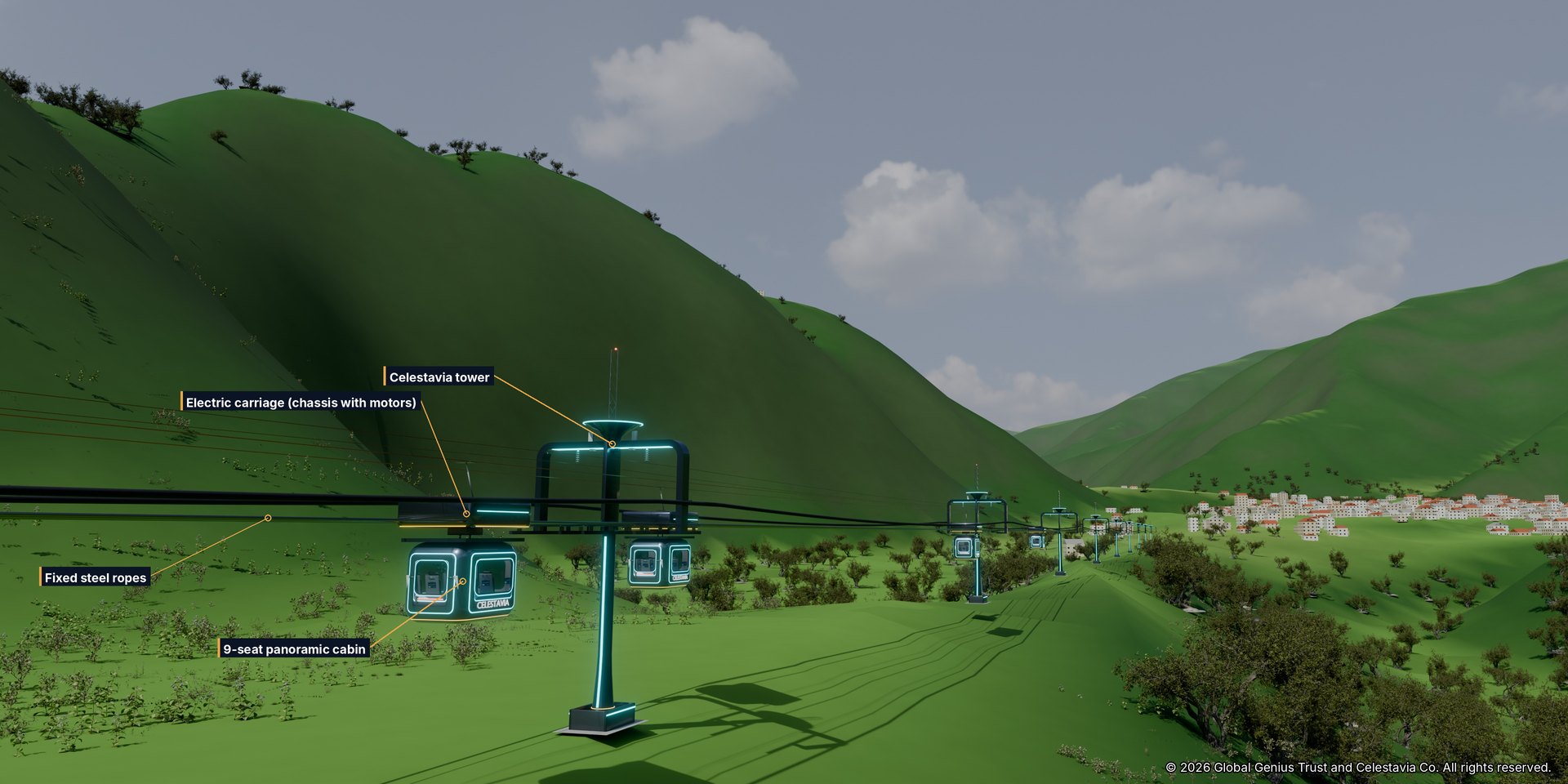
An aerial ride through the Pastaza canyon, waterfall to waterfall, with a theme-park ticket: it is not public transport, it is an attraction with a premium ticket and time slots booked in the app. Celestavia is an elevated system: electric carriages run along two large fixed steel ropes per track, carried by towers; the carriage moves, not the rope. Each cabin travels on its own: it slows down or stops in front of each waterfall without stopping the others. An investment project of its own, separate from the Ambato – Baños public line.
1.5 kV DC, 100 % electricGoal: zero accidentsPrivate concession; the State contributes land and the concessionNote. Projections, not guarantees. Costs are ranges until suppliers quote. Real-world data (population, fleets, fares, visitors, hazards) carry their source and year. Versión en español.
The long-term vision: Baños – Ambato, Ecuador’s flagship destination
Baños already has what Orlando, Florida, did not have in 1970: a famous name, about 2 million visits a year, waterfalls, hot springs, a volcano and a mild climate all year round. We propose to turn the Ambato – Pelileo – Baños – Río Verde corridor into Ecuador’s flagship destination, with a chain of attractions that opens in seven phases from 2030 to 2045 and beyond. Celestavia is the backbone: it links every attraction and is the only way into the most sensitive sites, with no new roads into the forest and no car parks. “The next Orlando” is a city comparison: Baños grows its own way, with its nature and its people.
Seven phases, from 2030 to 2045 and beyond
- Waterfalls Route aerial ride: Baños – Agoyán – Manto de la Novia – Río Verde, 16.6 km above the Pastaza canyon
- Waterfalls by Night: an evening light-and-sound walk, with warm lighting and hours that protect birds and bats
- Adventure pass with the Baños operators (bridge jumping, rafting, canyoning, swings and zip lines) on one ticket
- Terminal plaza with local shops
Opens with today’s visitors and modest growth.
- Runtún climb, the lookout above Baños and Tungurahua
- “Ride up, walk down”: the Runtún summit stop with a café, viewing deck and first aid, and three graded trails down with viewpoints
- Volcano and Sky Centre: live monitoring, the 1999–2016 story, the evacuation drill and a planetarium (to be proposed to the Geophysical Institute)
- Agua Santa thermal spa, beside the municipal pools and never instead of them (an option for private hotels)
Once Phase I shows its demand.
- Native butterfly and orchid conservatory at Río Verde: Ecuador has about 4,000 butterfly species and more than 4,450 orchid species
- Ambato fruit and flower park, home of the Fruit and Flower Festival (a municipal project served by Celestavia)
- Industry tours and an outlet village: footwear, leather, Pelileo jeans and Tungurahua’s bus-body makers
Industry tours from the start; the conservatory once visits grow by about 50 %.
- Andean-Amazon wildlife rescue sanctuary seen from above: rescued spectacled bears, mountain tapirs, condors, jaguars, monkeys and macaws; rescue, rehabilitation, release where possible and education, with Ecuador’s environment ministry (MAATE) and licensed rescue centres; a slow aerial loop
- Thermal water park: in and out only by Celestavia, with no new roads or car parks
- Hotels and resorts, growing with occupancy
- Proposed site: the Pastaza Valley bench near Pelileo, beside the public line (alternative: the Mera – Shell plain), subject to a site study
When Baños approaches the “next Orlando” path.
- Ambato convention and fair centre
- Performing arts centre
- Film studios with an Andean-town backlot, once an anchor studio takes the stages
Civic works of the city and the province, served by Celestavia.
- Latin American food and culture pavilion: twelve countries around a lagoon, each with its restaurant, crafts, music and dance
- Each pavilion fitted out and run with embassies, binational chambers and tourism boards
When visits approach three times the base path.
- All-weather entertainment dome: a 360° immersive theatre, concerts and eSports (casino-free)
- Themed lands: Amazon, Andes, Galápagos and Volcano
- Amazon gateway at Mera – Shell: an extension of about 28 km, with the consent of the Kichwa and Shuar communities
Long-term options: only if the destination reaches that scale.
The phases on the map
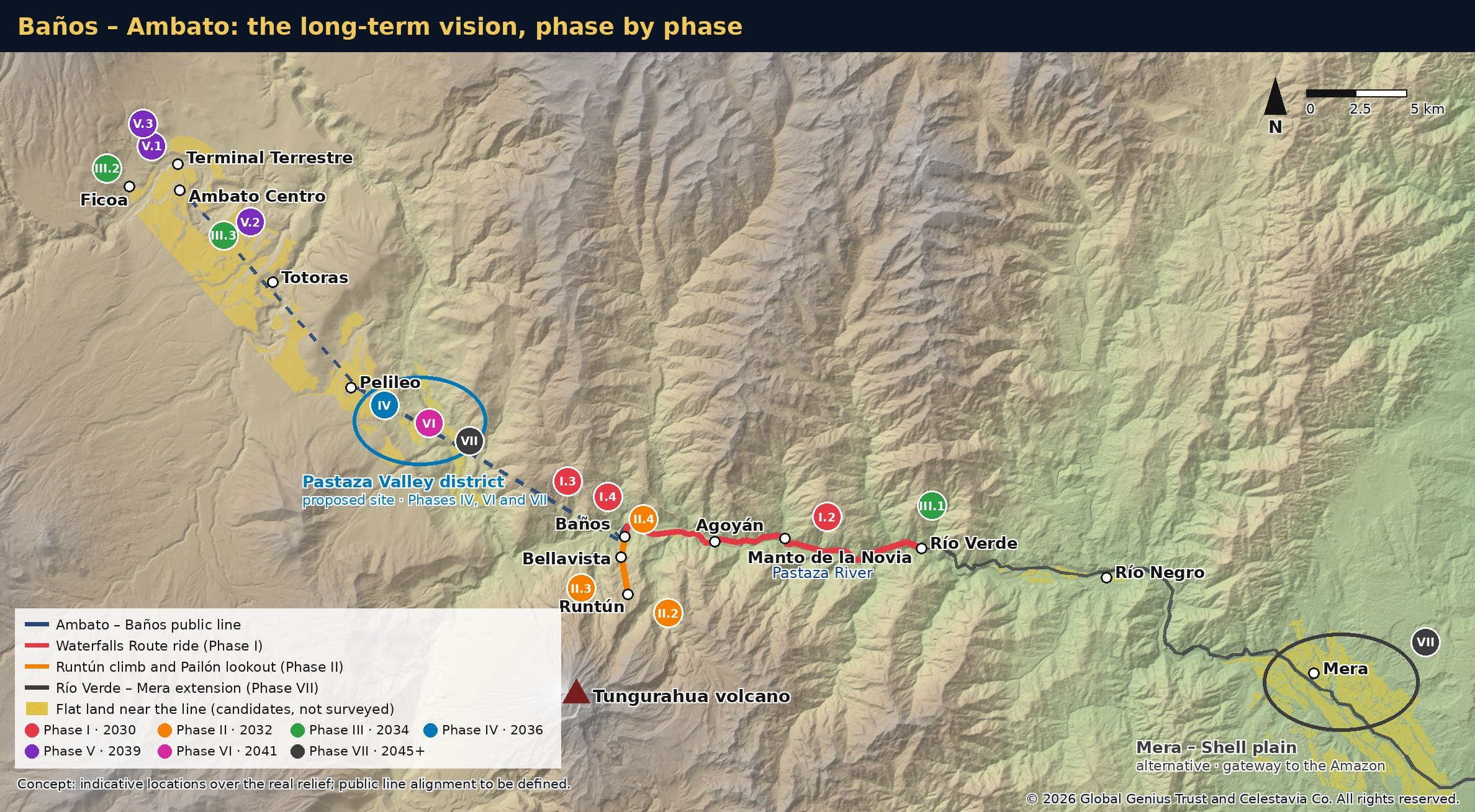
Where the district goes: proposed site, subject to a site study. We propose the flat bench in the Pastaza Valley, on the west bank of the Patate river, about 4 km south-east of Pelileo and about 12 km from Baños, beside the Ambato – Baños public line. It needs only a short spur from the line, sits close to Ambato and Baños, has a mild and drier climate, and is farmland outside the Llanganates – Sangay connectivity corridor. Its weak point is volcanic ash, which the winds carry west: it is handled with roofs and shelters designed for ash and with the alert protocol. The alternative is the Mera – Shell plain: warmer and away from the ash, but it needs about 28 km more line, is very rainy and the line would cross the connectivity corridor. A site study (the Geophysical Institute’s hazard maps, soils and land ownership) will decide.
What it means for Ecuador
More visits, longer stays
From about 2 million visits a year to between 3.6 and 9.1 million in 2050. With more to do, visitors stay longer and come back; the foreign share can rise from 12 % to 25 %.
Jobs for local people
Between 5,200 and 8,600 people in permanent jobs at the attractions, 2,800 to 22,600 more in hotels, restaurants, transport and guiding, and about 1,400 to 2,100 people working on construction each year, on average, until 2050.
National tourism
A flagship destination about 3 hours from Quito and a day from Guayaquil, giving Ecuador one more reason to come and stay, alongside Galápagos, the Amazon and the Andes.
The gateway to the Amazon
Baños is the pass from the Andes to the Amazon. The network can continue to Mera – Shell and Puyo above the landslides that cut the Baños – Puyo road in 2024, 2025 and 2026.
Investment mostly private
US$1.3 to 1.8 bn to 2050: US$1.0–1.5 bn from the investors and operators of each attraction, US$200–300 M from Celestavia for its lines and about US$90–100 M of civic works (convention centre and theatre). The State and the municipalities contribute the concession and the land (~20 %, in kind).
Celestavia, the backbone
One electric network at 1.5 kV DC links Ambato, Pelileo, Baños, Runtún and Río Verde, with bookings in the app: passengers who book arrive on time and do not wait. The district attractions are reached only by Celestavia.
Each phase opens when its visitors arrive
Nothing is built ahead of its time. Each attraction has its threshold: it is built when visits reach the level that makes it pay, by its own investors and operators. Phases I and II are Celestavia’s own business and work with modest growth in visits; the butterfly conservatory comes when visits grow by about 50 %; the water park, the wildlife sanctuary and the Plaza of the Americas when Baños approaches two and a half to three times the visits of the base path. The civic works (convention centre, theatre, fruit park) are decided by the city, the province and the national government, and Celestavia serves them.
The volcano and nature first
- The volcano comes first. An alert protocol with the Geophysical Institute: on an alert the cabins return to the stations; the Runtún trails close at orange alert; towers stay out of the lahar channels (Vazcún, Ulba, Juive).
- No new roads into the forest. The remote sites are reached only by Celestavia, with no car parks; towers stay out of the river and its protection strip.
- A native-wildlife sanctuary. Only rescued native animals, legally sourced: rescue, rehabilitation and release where possible, welfare first and no animal shows.
- Light and landscape cared for. Night lighting only after an impact study; the Llanganates – Sangay connectivity corridor and the national parks are respected.
- With the communities. The Baños operators are partners, not competitors; the Amazon gateway only with the free, prior and informed consent of the communities.
What is firm and what is an option
Firm: the waterfalls ride, the night walk, the adventure pass, Runtún and the industry tours work from moderate demand. With more visitors: the butterfly conservatory, the water park, the wildlife sanctuary and the Plaza of the Americas come with the “next Orlando” path. Long-term options, not promises: the entertainment dome, the themed lands, the film studios (with an anchor studio) and the Amazon gateway (the public line’s task) are prepared today and decided when the destination reaches that scale.
Join the vision
This vision is for Ecuador. Whether you are a citizen, a business, a public authority or an investor, if you want Baños – Ambato to become the country’s flagship destination, join us: leave your details and we will write to you with every step. You can also write to us directly in the Contact section (WhatsApp, Telegram and email).
Summary for investors
The opportunity. Baños de Agua Santa is one of Ecuador’s most visited destinations: about 115,000 visitors over the three-day August 2024 holiday (Baños municipality, via Primicias) and about 40,000 a day over New Year 2025 (municipal projection, KCH Comunicación). We estimate 1.2 to 3.0 million visits a year (2.0 million as the central value); there is no official annual series. Today visitors travel the Waterfalls Route by bus, open-sided “chiva” or bicycle along the E30 road.
The product. An aerial recreational park: Phase A runs 16.6 km through the Pastaza canyon (Agoyán, Manto de la Novia, Río Verde, a few minutes’ walk from the Pailón del Diablo); Phase B adds the Runtún climb, the volcano lookout, with 833 m of rise. Premium ticket with packages, booked time slots and holiday prices; those who book arrive on time and do not wait.
Two cases, side by side. The promoter’s case (9 in 10 visitors buy the ride at US$25 and some repeat): P50 investment of US$81 M, revenue of US$44.8 M a year, a private investor IRR of 37.7 % and payback in 3 years. Base case (the take-up of comparable attractions): US$64 M, US$12.6 M a year and 9.1 %. The share of visitors who buy the ride decides the investment; to reach 15 % the base case needs about 1.5 times its passengers.
The next Orlando. A signature attraction does not only sell tickets to today’s visitors: it draws new ones. With a mid projection (+30 % visits in 12 years) the base-case IRR rises to 13.9 %; with a high one (visits doubled in 15 years, still far below Da Nang or Orlando) it reaches 19.2 %, and the extra visitor spending in Baños grows from US$6.3 M to US$151 M a year.
Videos
How Celestavia works, in five short videos: the cabin, cargo, the small station, the megastation and the health app.
The opportunity: Baños, the next Orlando
Orlando, Florida, received about 660,000 visitors a year before 1971; with its parks, its airport and its hotels it reached 76.7 million in 2025. Ba Na Hills, in Da Nang (Vietnam), was an almost abandoned hill station until a cable car and a park made it the place that two in three of the city’s foreign visitors go to. Baños already has what those places had to build: a volcano, waterfalls, hot springs, adventure sports and millions of visitors. What it lacks is a signature attraction that makes visitors stay one more day, come back and tell others.
What happened elsewhere
| Destination | Before and after | Source |
|---|---|---|
| Orlando, Florida (United States) | ~660,000 visitors a year in 1970, before its first big theme park (1971); 32.4 million in 1995; 76.7 million in 2025 | Frommer’s (1970); Visit Orlando (1995, 2025) |
| Ba Na Hills, Da Nang (Vietnam) | ~30,000–40,000 visitors a year until 2009; cable car since March 2009; more than 160 times as many visitors in 2018. Da Nang grew from ~1.7 million visitors (2010) to ~8.6 million (2019) | VnExpress International; VietnamNet; Da Nang Department of Tourism (2019-2024) |
| Table Mountain Aerial Cableway, Cape Town (South Africa) | after the 1997 upgrade (cabins from 25 to 65 people), about 700,000 visitors a year; close to 1 million in 2023 | operator annual report, 2013; Wesgro, 2024 |
| Quito cable car (Ecuador) | ~1 million visitors in its first 12 months (2005-06); ~300,000 a year since 2007-08, once the novelty wore off | Expreso (operator interview); Primicias, 2024 |
| Mérida cable car (Venezuela) | 2.2 million visitors between April 2016 and August 2023 (~300,000 a year), in the middle of an economic crisis | operator via the press, 2023 |
These cases show what an attraction can trigger, not what will happen in Baños: Orlando and Da Nang grew with airports, hotels and several attractions over decades, and the Quito and Mérida cable cars show that novelty can also fade.
Projection: new visitors drawn by the park
On top of today’s 2.0 million visits (with their normal growth of 1.5 % a year for 10 years), we add new visitors who come because of the park, in three bands read from those cases: low (+5 %, a novelty that fades), mid (+30 % in 12 years, an attraction that takes hold) and high (visits doubled in 15 years; Da Nang grew almost five times in nine). Of those new visitors, 6 in 10 buy the ride. The fleet grows with them up to the limit of the track. Phase A, base case:
| Band | Visitors year 5 | Year 10 | Year 15 | Park passengers, year 15 | Revenue, year 15 | Investor IRR |
|---|---|---|---|---|---|---|
| No induced visitors (normal growth only) | 2.12 M | 2.29 M | 2.32 M | 492 thousand | US$14.5 M | 9.1 % |
| Low projection: +5 % in 10 years | 2.17 M | 2.39 M | 2.42 M | 555 thousand | US$16.1 M | 10.1 % |
| Mid projection: +30 % in 12 years | 2.35 M | 2.84 M | 2.92 M | 870 thousand | US$24.5 M | 13.9 % |
| High projection: visits doubled in 15 years | 2.64 M | 3.77 M | 4.32 M | 1,721 thousand | US$47.1 M | 19.2 % |
A projection, not a forecast
The bands are our reading of comparable destinations, not Baños data. The base case, without induced visitors, remains the reference for the investment; the projection shows the potential added if Baños follows the path of those destinations.
Phases A and B, with map
Phase A, Waterfalls Route (16.6 km): from a terminal beside the Baños station of the public line, through the Pastaza canyon: the Agoyán waterfall and dam, Manto de la Novia and San Pedro, to Río Verde, a 15–20 minute walk from the Pailón del Diablo. 72 minutes on board, round trip, with stops in front of the waterfalls. Where the road goes into tunnels, the line crosses the canyon with long spans from tower to tower, with no towers in the river. Steepest grade on the route 20 %: standard carriage.
Phase B, Runtún climb and Pailón lookout (19.6 km in total): 833 m of rise over 2.9 km, with a first span of ~1,030 m over the escarpment above Baños and a view of the Tungurahua volcano; a short spur goes down to the Pailón lookout. The carriages of this phase carry powered counter-rollers for the steep grades (up to ~80 % on a wet rope). Additional P50 cost: US$17–18 M. Built once Phase A shows its demand.
Long-term option, not included in any cost: the 600 m drop inside the mountain in the original proposal (a 1 km tunnel at a 75 % grade) exceeds the grip of the wheels: it would need a haul rope or an inclined lift and the tunnel, about US$35 M more. The open-air descent from Runtún offers 833 m of drop with a view of the volcano.
Tickets and packages
In each case the price with the best return was chosen counting the fleet and the berths each price requires (adult prices incl. VAT; statutory discounts for seniors and people with disabilities):
| Phase A | Base case | Promoter’s case |
|---|---|---|
| Adult ticket, national | US$27 | US$45 |
| Adult ticket, foreign | US$54 | US$72 |
| Average revenue per passenger (excl. VAT; tickets, own retail, sponsorship and other income) | US$29.69 | US$42.88 |
| Phase A + B (full circuit), national / foreign | US$35 / 60 | US$50 / 80 |
Price references in the region: zip lines and “tarabita” cable crossings in Baños US$27–67 and a shared Waterfalls Route tour US$35 (agencies, 2025); a park with a 6.3 km cable car over a canyon in Colombia, ~US$21 (Infobae, 2025); Table Mountain cableway, ~US$27 return (2025); Ba Na Hills, ~US$37 (2025).
Tiered tickets: national, Andean Community and Mercosur, foreign
In Ecuador and across the Andes it is common for foreign visitors to pay several times what nationals pay. Since 1 August 2024 the Galápagos National Park charges US$30 to national visitors, US$100 to visitors from the Andean Community or Mercosur and US$200 to foreigners: 6.7 times the national price (Galápagos Government Council, resolution 002-CGREG-24-02-2024). At Machu Picchu foreigners pay about 2.4 times what Peruvians and Andean Community citizens pay (~S/ 152 against ~S/ 64, Peru’s Ministry of Culture, 2026 rates); on the Quito cable car, 1.7 times (US$9 against US$5.25, Expreso 2023).
Proposed structure for the park: the national price stays affordable and foreigners pay 3 times the national price; the Andean Community and Mercosur pay half the foreign price.
| Phase A | National and resident | Andean Community and Mercosur | Foreign | IRR with today’s ticket (national / foreign) | IRR with tiered tickets (case response / foreigners who see it as a must) |
|---|---|---|---|---|---|
| Base case | US$27 | US$40 | US$81 | 9.1 % | 8.6 % / 10.4 % |
| Promoter’s case | US$45 | US$68 | US$135 | 37.7 % | 37.0 % / 39.2 % |
What it adds and what it depends on: foreigners are few (about 10 % of holiday bookings, Ministry of Tourism 2025; the model uses 12 % of visits). With each case’s price response, charging 3 times changes the IRR by -0.5 points (base case) and -0.7 (promoter), because some foreigners are lost; if foreigners see the park as a must, as in Galápagos, it adds +0.7 and +0.8 points. Charging 5 to 10 times only pays in that case, and even then loses foreigners. More foreign visitors matter more: if they rise from 12 % to 30 % of visits, the base-case IRR rises from 9.1 % to 12.1 %–16.2 % with the proposed structure. Checked against Celestavia’s common fare rule (a constant price response), charging 5 times would add 7 % to ticket revenue at the cost of 68 in every 100 foreign passengers; 3 times is kept, the option with the least risk.
- Day pass: hop on and off at every stop, with a booked departure time.
- Sunset ride and illuminated night rides in season.
- Combos with the municipal hot springs, the Pailón trails and the zip-line and cable-crossing operators (partners, not competitors).
- Family (four people), two days, holiday surcharge and a resident price for Baños and Tungurahua.
- Private cabin: a group that does not want to share books the whole cabin for 3.5 times the ticket; the model assumes 8 in every 100 groups do so.
Other income, beyond the ticket
Beyond tickets, own retail (food, shop, photos) and sponsorship, the park counts every income stream its line and stations allow. Each one is counted net of what it costs to provide, with a low–high range, at Ecuadorian prices and with its own ramp-up of 1 to 4 years:
| Income stream (net, mature year) | Base case, US$ thousand a year (low–high) | Promoter’s case, US$ thousand a year |
|---|---|---|
| Private cabin (on top of the ticket) | 929 | 3,562 |
| Advertising inside and outside the cabins, at the stations and in the app | 29 (9–73) | 69 |
| Rental of kiosks, cafés and cash machines at the stations | 3 (1–9) | 3 |
| Luggage and parcel lockers at the stations | 20 (3–99) | 20 |
| Towers for mobile operators (sites and 5G cells), backbone fibre and on-board wifi | 203 (96–360) | 205 |
| Paid parking with electric-vehicle charging | 134 (68–220) | 134 |
| Services to the power grid from the tower and station batteries | 5 (0–16) | 5 |
| Paid public services: emergency and rescue support; seismic, volcanic, weather and air-quality data; traffic cameras | 9 (0–34) | 9 |
| Waste collection at the stations | 4 (1–14) | 4 |
| Bookings in the app and anonymous mobility data | 4 (1–13) | 9 |
| Combined packages (hot springs, zip lines, cable crossings, trails) and events | 433 (197–1,092) | 935 |
| Cabin rental for events, celebrations and filming | 4 (1–13) | 9 |
| Total beyond tickets, own retail and sponsorship | 1,775 | 4,963 |
Phase A, 2026 US$, after the 4 % of revenue lost to ash days and road closures. Across the whole range of these streams the base-case IRR goes from 8.4 % to 10.7 %. Light cargo, parcel mail and land-value capture around the stations are not counted (an option, outside the case); sponsorship is already in the case. Paid public services are service contracts: they are not part of the State’s contribution (concession and land, ~20 %, in kind) and give it no additional share.
Investment
Capital cost in 2026 US$, excluding VAT: line, towers, ropes, power at 1.5 kV DC, stations and visitor buildings, the opening fleet (carriages and 9-seat cabins priced as series automotive parts), systems, studies and easements. P10–P50–P90 range from 20,000 scenarios of prices and quantities; cost per km with and without stations computed in each scenario. The State or the municipality contributes the concession and the land (~20 % of the project, in kind, outside the cash capital) and shares in the dividends; private investors put in 40 % of the cash capital and debt 60 %.
| Package | km | Investment P10–P50–P90 | US$ M per km with / without stations (P50) | Opening cabins | Private equity / debt (P50) |
|---|---|---|---|---|---|
| Phase A, base case | 16.6 | US$58–64–70 M | 3.84 / 3.13 | 139 | US$25 M / 38 M |
| Phase A, promoter’s case | 16.6 | US$74–81–88 M | 4.88 / 3.86 | 342 | US$32 M / 49 M |
| Phase A + B, base case | 19.6 | US$74–80–88 M | 4.10 / 3.32 | 211 | US$32 M / 48 M |
| Phase A + B, promoter’s case | 19.6 | US$91–99–108 M | 5.04 / 3.99 | 384 | US$40 M / 59 M |
Largest Phase A items, base case (P50): Fleet (carriages, cabins and experience fit-out) US$7.4 M; Track ropes US$6.8 M; Towers and foundations US$6.1 M; 1.5 kV DC substations US$5.2 M; Visitor buildings (terminal and Río Verde) US$4.2 M; Signalling, fibre, 5G and sensors US$4.1 M; Long spans over the canyon US$3.3 M; Operations room (part of a regional centre) US$3.1 M. No own high-voltage line: Baños has a grid and the Agoyán power plant next to the route (one grid connection).
Returns: base case and promoter’s case
Base case: the take-up of comparable tourist cable attractions (30 % of national visitors and 45 % of foreign visitors at US$25 and US$45). Promoter’s case: with a US$25 ticket, 9 in 10 visitors buy the ride and 1 in 5 repeats; as its demand yields little to price, its best return comes with a higher ticket. In each case the ticket and the fleet with the best return are chosen; mature year, 2026 US$.
| Phase A, Waterfalls Route | Base case | Promoter’s case |
|---|---|---|
| Visitors a year (central assumption) | 2.0 million | 2.0 million |
| Rides sold per 100 visits | 21 | 52 |
| Passengers a year | 424,000 | 1,044,000 |
| Revenue a year (excl. VAT) | US$12.6 M | US$44.8 M |
| of which private cabin and other income | US$1.8 M | US$5.0 M |
| Operation and maintenance a year | US$4.8 M | US$10.1 M |
| EBITDA a year | US$7.8 M | US$34.7 M |
| Private investor IRR (P50 / P90 investment) | 9.1 % / 7.8 % | 37.7 % / 34.6 % |
| Project IRR | 9.6 % | 26.7 % |
| Debt service cover (DSCR minimum / mean) | 1.33 / 1.63 | 4.81 / 5.71 |
| Payback of the equity | 13 years from opening | 3 years from opening |
If the promoter’s demand proves true on the system sized for the base case (the upside for the investor): 989,000 passengers, US$27.6 M a year and an IRR of 28.2 %, with payback in 4 years; cabins are added to serve the demand left over.
With the induced-visitor projection
| Induced-visitor band | Base case: IRR · payback | Promoter’s case: IRR · payback |
|---|---|---|
| No induced visitors | 9.1 % · 13 years | 37.7 % · 3 years |
| Low projection (+5 %) | 10.1 % · 13 years | 38.2 % · 3 years |
| Mid projection (+30 %) | 13.9 % · 10 years | 40.3 % · 3 years |
| High projection (doubled) | 19.2 % · 8 years | 42.5 % · 3 years |
What decides the investment
The share of visitors who buy the ride and the new visitors the park attracts. The base case alone, without induced visitors, returns 9.1 %: to reach 15 % it needs about 1.5 times its passengers, which the high projection reaches between years 1 and 5. Every case includes 4 % of revenue lost to ash days and road closures, property and catastrophe insurance and business-interruption insurance.
Capacity and booked time slots
About half of all visits come on some 30 holiday days, with peaks of about 40,000 visitors a day. Carrying 90 % of them on the busiest day would need 4,169 boardings in the peak hour, 18-seat cabins and an investment of close to US$178 M: it costs more than it earns. So the park is sized for about 80 % of the peak day, sells time slots in the app (those who book arrive on time and do not wait), charges more on holidays and adds cabins as demand grows.
| Phase A | Base case | Promoter’s case |
|---|---|---|
| 9-seat cabins (opening) | 139 | 342 |
| Boardings in the peak hour of the design day | 664 | 1,641 |
| Cabins per hour and direction (the track allows 360) | 89 | 219 |
| Rides a day it can serve | 6,947 | 17,094 |
| Demand left over at the peaks | 2 % | 2 % |
| Berths at the terminal | 4 | 10 |
With relative braking (each carriage follows the one ahead at its braking distance plus a margin, under signalling), the open-line headway at 30 km/h is about 3.3 s; the design uses 10 s to include station entries and exits. 13 effective operating hours a day.
Jobs and the local economy
| Phase A | Base case | Promoter’s case |
|---|---|---|
| People at work each year of construction (2 years) | 350–430 | 450–550 |
| Permanent jobs at the park | 162 | 256 |
| Extra visitor spending in Baños a year (at opening) | US$6.0 M | US$19.9 M |
| Extra spending in year 15, mid / high projection | US$47 / 151 M | US$56 / 158 M |
| Jobs in hotels, restaurants, transport and guiding, year 15 (mid / high) | 2,334 / 7,544 | 2,818 / 7,887 |
The extra spending counts those who stay one more day because of the park and the new visitors (1.8 days each, US$40 per visitor-day according to the municipal estimate); tourism jobs are estimated at one per US$20,000 of visitor spending. The local operators (cable crossings, zip lines, trails, hot springs) sell combined tickets and share the flow of visitors.
How it supports the Ambato – Baños public line
The park shares with the Ambato – Baños public line the Baños station, the operations room, the workshops and the grid connection, and its Waterfalls Route is the first stretch of a future Baños – Puyo extension built to the same standard, on which the public line could run under an access agreement.
Only in the high cases could the park contribute to a fund for the public line without its investors’ return falling below 15 %: up to US$20.8 M a year in the promoter’s case, or US$9.3 M if that demand arrives on the base-case system. In the base case there is no surplus for that fund: the public line is financed by its own options.
Volcano, landslides and insurance
- Tungurahua volcano: eruptive period 1999–2016; Baños was evacuated in October 1999 and there were pyroclastic flows in 2006 (Geophysical Institute). Towers outside the lahar channels (Vazcún, Ulba and Juive ravines), with long spans over them; a volcanic alert protocol with the Geophysical Institute: on an alert, the cabins return to the stations.
- Landslides in the Pastaza canyon: the 16–18 June 2024 landslide closed the Baños – Puyo road (losses of ~US$12 million a month in Tungurahua and Pastaza; tourism −50 % for weeks, Primicias 2024); there were closures in December 2025 and in May and June 2026. The line passes above the road with long spans, drainage and slope anchors.
- Earthquakes: seismic design for zone V (Z = 0.40 g, NEC-15).
- In the financial model: property and catastrophe insurance (0.6 % of the investment a year), business-interruption insurance (1.5 % of revenue) and 4 % of revenue lost each year to ash days and road closures.
- Monitoring: fibre, 5G, cameras and seismic and weather sensors on every tower, with batteries for 21 days without the grid; every battery sits in a fireproof container with its own fire-suppression system.
Schedule
| Stage | When (estimate) | What it includes |
|---|---|---|
| Phase 0 | 2027 – mid-2028 | Feasibility studies, design, concession with the municipality and the State, environmental licence, agreements with local operators and system certification (completed in Phase 0) |
| Phase A construction | mid-2028 – mid-2030 | Towers, ropes, stations, power and fleet (2 years; carriages and cabins built in parallel by contracted manufacturers) |
| Phase A opening | around mid-2030 | Gradual start: 80 % of mature demand in the first year, 95 % in the second |
| Phase B decision and construction | operating years 2–4 | Runtún climb and Pailón lookout, once Phase A shows its demand |
Indicative dates; they depend on the concession, the land and the licences.
Method and data to request later
Celestavia’s own simulation platform: a concept alignment over a 30 m elevation model (no topographic survey), a grade and grip check, visitors per day (holidays, weekends and weekdays) built from public counts, demand response to price, track, berth and fleet capacity on the peak days, costs with 20,000 scenarios (items from the Ecuador national study) and a concession model with debt, taxes and the State’s share. The induced-visitor projection is read from comparable destinations with their source and year. Public sources with their year; no official information has been requested yet.
Next study steps: a willingness-to-pay survey of Baños visitors (on a holiday and in a normal week) to measure the share that would buy the ride, repeat visits and price; it is the study that separates the base case from the promoter’s case. Then the topographic survey, geotechnical and hazard studies, and the design of the visitor buildings.
Data to request later:
- Visitor arrivals in Baños by day, origin and mode of transport (Baños municipality, Ministry of Tourism).
- Hotel occupancy and the Baños accommodation register, including informal lodging.
- Spending per visitor and length of stay.
- Volcanic hazard maps (Tungurahua lahars) and landslide maps of the Pastaza canyon.
- Municipal land available for the terminal and the stations; easements along the E30.
- Spare capacity in the Baños power grid and the tariff schedule.
- Tax incentives applicable to tourism investments.
Contact
Elevated suspended transport for people and cargo, 100 % electric, with the goal of zero accidents.
Projects
Celestavia
 Global Genius Trust