Celestavia for Ecuador · Ruta del Progreso por la Equidad y la Paz
Personal & cargo rapid transit by Celestavia
Revolutionizing transportation: safer, faster, cleaner, and sustainably engineered.
Total investment: $109,676 million USD 4,887 km of routes Operational in 2–3 yearsExecutive summary
CELESTAVIA is an innovative, integrated international multi-development system set to transform agriculture, transportation, trade, tourism, health, education, gastronomy, and much more across all of Ecuador. It is a 100% electric, suspended-cable aerial transit system that would link Colombia with Peru and the Amazon, with an estimated total cost of $110,000 million dollars.
Connects Ecuador like never before
With a network of 4,887 km of suspended aerial cable transport, integrated with road and rail systems from Colombia to Peru and the Amazon, CELESTAVIA links cities, provinces, and historically isolated territories.
Drives the economy
Multimodal infrastructure with cargo and passenger capacity, designed to meet the country’s logistics and commercial demands while reducing transport times and costs.
Environmental respect
A 100% electric system with minimal ecological footprint, preserving the unique biodiversity of Ecuador’s forests, páramos, and coasts.
Generates employment and development
Through growth in organic, sustainable agricultural production, tourism development, transportation, and communication across the national territory.
Promotes eco-tourism
New routes connecting national parks and ecological reserve zones of interest to international tourism, preserving the ecosystem while generating new sources of wealth and employment.
Promotes health and wellbeing
Promotion of healthy nutrition through organic production and distribution networks, integrating ancestral knowledge with modern technology, and new holistic health centers.
Innovates in technology
5G and fiber-optic communication along the entire route, AI for security, autonomous transport, climate and seismic monitoring, and a new industry built on basalt mineral and 3D-printed construction.
Transforms education for development
Elementary, secondary, and higher education schools, as well as universities with technical and professional programs oriented to the project’s development, training rural workers and improving their income levels.
Brings prosperity to communities
With investments of nearly $40,865 million USD, the project projects comprehensive coverage in health, education, housing, basic services, and infrastructure, with a focus on including the most vulnerable populations.
CELESTAVIA: Smart infrastructure to connect Ecuador’s future
Ecuador faces major challenges in connectivity, logistics, and territorial integration that limit the economic, agro-industrial, tourism, and social development of large regions of the country. In response to these challenges, CELESTAVIA stands as one of the strategic components of the Ruta del Progreso por la Equidad y la Paz macro-project, through a modern national network of suspended aerial cable transport designed to integrate the territory efficiently, sustainably, and with deep respect for natural heritage.
With a projected network of 4,887 kilometers, CELESTAVIA will connect agro-industrial production centers, cities, municipalities, maritime and river ports, airports, industrial parks, logistics platforms, rural areas, and strategic corridors, strengthening national competitiveness and generating new economic and social development opportunities for millions of Ecuadorians.
More than a transportation system, CELESTAVIA is a high-impact international logistics solution connecting Ecuador with Colombia to the north and Peru to the south, facilitating multimodal corridors for passenger and cargo transport along the entire Andean and Amazonian axis. Its modular, scalable, prefabricated design allows the network to be built in approximately two to three years, offering a rapid-implementation alternative to large conventional infrastructure projects and bringing economic and social benefits to the country in a considerably shorter timeframe.
Its design meets the highest standards of environmental sustainability. The infrastructure requires minimal ground intervention, with support towers generally spaced every 100 meters, or farther apart where terrain allows. In environmentally sensitive ecosystems — national parks, forest reserves, the Amazon, wetlands, coastal mangroves, and Andean páramos — the system can span distances of over a kilometer between towers, avoiding direct ground intervention and allowing protected areas to be crossed without fragmenting ecosystems.
This technological capability preserves Ecuador’s extraordinary biodiversity — one of the planet’s megadiverse countries, spanning coast, highlands, Amazon, and Galápagos — protecting fauna and flora, conserving biological corridors, maintaining ecological connectivity, and respecting the natural flow of surface and groundwater, minimizing disruption to biota and significantly reducing environmental impact compared to traditional highways, which require extensive earthmoving, deforestation, and permanent landscape modification.
Operating entirely on electric power, CELESTAVIA helps reduce greenhouse gas emissions, lower the transportation sector’s carbon footprint, and establish an infrastructure model aligned with the principles of sustainable development, climate change adaptation, and the protection of Ecuador’s natural resources.
CELESTAVIA is conceived as a national multimodal transport system, fully integrated with highways, rail corridors, maritime ports, river ports, airports, logistics platforms, free trade zones, and agro-industrial production centers — optimizing the movement of passengers and goods, reducing logistics costs, and strengthening the country’s competitiveness in domestic and international markets.
As a structural component of the Ruta del Progreso por la Equidad y la Paz macro-project, CELESTAVIA facilitates the industrialization of the countryside, strengthens food security, drives agro-industrial transformation, promotes eco-tourism, energizes regional and international trade, and creates conditions for sustainable economic growth across all regions.
Its implementation represents a powerful tool of social transformation, giving millions of Ecuadorians access to health, education, housing, employment, digital connectivity, markets, culture, and investment opportunities — especially in historically excluded territories. Border provinces with Colombia and Peru, the Amazon region, and coastal areas will be able to fully integrate into national development through sustainable economic alternatives, strengthening the State’s institutional presence and promoting the consolidation of territorial peace.
CELESTAVIA also drives the creation of new development hubs around its stations, promoting agro-industrial parks, logistics centers, tourism complexes, innovation centers, educational institutions, hospitals, regional markets, and new opportunities for public and private investment — generating formal employment, strengthening local economies, and improving communities’ quality of life.
With resilient, clean, efficient, and rapidly-built infrastructure, CELESTAVIA represents a new vision for national development: a territorial integration network connecting Ecuador with its Andean neighbors, boosting its competitiveness as a regional logistics platform and consolidating a growth model built on innovation, sustainability, equity, and peace.
Grupo Genio (Global Genius Trust) has hundreds of projects underway, of which only a few holistic basic-infrastructure multi-projects are presented here. Grupo Genio has spent more than twenty years working to solve a significant share of humanity’s problems, committed to not repeating the mistakes of the past.
CELESTAVIA doesn’t just connect destinations; it connects opportunities, protects Ecuador’s natural wealth, and builds strategic infrastructure for present and future generations — becoming one of the fundamental pillars of the Ruta del Progreso por la Equidad y la Paz macro-project.
Specific objectives, grounded in our Creole Ideology
What is our Creole Ideology? A development philosophy conceived by Juan Carlos Fuentes Cuello — founding president of FUNDA A AFI Internacional — drawn from decades of work alongside Colombian communities and exchanges with social, economic, and political sectors across Europe and South America. It holds that equity and peace are built through the permanent generation of new wealth and equal opportunity. Read the full foundation →
Ecuador faces major challenges in connectivity, logistics, and territorial integration that limit the economic, agro-industrial, tourism, and social development of large regions of the country. In response to these challenges, CELESTAVIA stands as one of the strategic components of the Ruta del Progreso por la Equidad y la Paz macro-project, through a modern national network of suspended aerial cable transport designed to integrate the territory efficiently, sustainably, and with deep respect for natural heritage.
With a projected network of 4,887 kilometers, CELESTAVIA will connect agro-industrial production centers, cities, municipalities, maritime and river ports, airports, industrial parks, logistics platforms, rural areas, and strategic corridors, strengthening national competitiveness and generating new economic and social development opportunities for millions of Ecuadorians.
More than a transportation system, CELESTAVIA is a high-impact international logistics solution connecting Ecuador with Colombia to the north and Peru to the south, facilitating multimodal corridors for passenger and cargo transport along the entire Andean and Amazonian axis. Its modular, scalable, prefabricated design allows the network to be built in approximately two to three years, offering a rapid-implementation alternative to large conventional infrastructure projects and bringing economic and social benefits to the country in a considerably shorter timeframe.
Its design meets the highest standards of environmental sustainability. The infrastructure requires minimal ground intervention, with support towers generally spaced every 100 meters, or farther apart where terrain allows. In environmentally sensitive ecosystems — national parks, forest reserves, the Amazon, wetlands, coastal mangroves, and Andean páramos — the system can span distances of over a kilometer between towers, avoiding direct ground intervention and allowing protected areas to be crossed without fragmenting ecosystems.
This technological capability preserves Ecuador’s extraordinary biodiversity — one of the planet’s megadiverse countries, spanning coast, highlands, Amazon, and Galápagos — protecting fauna and flora, conserving biological corridors, maintaining ecological connectivity, and respecting the natural flow of surface and groundwater, minimizing disruption to biota and significantly reducing environmental impact compared to traditional highways, which require extensive earthmoving, deforestation, and permanent landscape modification.
Operating entirely on electric power, CELESTAVIA helps reduce greenhouse gas emissions, lower the transportation sector’s carbon footprint, and establish an infrastructure model aligned with the principles of sustainable development, climate change adaptation, and the protection of Ecuador’s natural resources.
CELESTAVIA is conceived as a national multimodal transport system, fully integrated with highways, rail corridors, maritime ports, river ports, airports, logistics platforms, free trade zones, and agro-industrial production centers — optimizing the movement of passengers and goods, reducing logistics costs, and strengthening the country’s competitiveness in domestic and international markets.
As a structural component of the Ruta del Progreso por la Equidad y la Paz macro-project, CELESTAVIA facilitates the industrialization of the countryside, strengthens food security, drives agro-industrial transformation, promotes eco-tourism, energizes regional and international trade, and creates conditions for sustainable economic growth across all regions.
Its implementation represents a powerful tool of social transformation, giving millions of Ecuadorians access to health, education, housing, employment, digital connectivity, markets, culture, and investment opportunities — especially in historically excluded territories. Border provinces with Colombia and Peru, the Amazon region, and coastal areas will be able to fully integrate into national development through sustainable economic alternatives, strengthening the State’s institutional presence and promoting the consolidation of territorial peace.
CELESTAVIA also drives the creation of new development hubs around its stations, promoting agro-industrial parks, logistics centers, tourism complexes, innovation centers, educational institutions, hospitals, regional markets, and new opportunities for public and private investment — generating formal employment, strengthening local economies, and improving communities’ quality of life.
With resilient, clean, efficient, and rapidly-built infrastructure, CELESTAVIA represents a new vision for national development: a territorial integration network connecting Ecuador with its Andean neighbors, boosting its competitiveness as a regional logistics platform and consolidating a growth model built on innovation, sustainability, equity, and peace.
CELESTAVIA doesn’t just connect destinations; it connects opportunities, protects Ecuador’s natural wealth, and builds strategic infrastructure for present and future generations — becoming one of the fundamental pillars of the Ruta del Progreso por la Equidad y la Paz macro-project.
Specific objectives
- Transition to an ecological, sustainable, and economical transportation model with minimal environmental impact.
- Position Ecuador as a leader in the global sustainable organic and agro-industrial market.
- Pioneer Celestavia technology across the Americas.
- Pioneer the use of Ecuadorian basalt and silica at a 90% rate.
- Create agricultural collection and marketing centers in 100% of productive provinces.
- Position Ecuador for new technologies such as air and space taxis.
Benefits of Celestavia
- A high-capacity transportation alternative.
- Lower environmental impact and lower cost per trip.
- Strengthening of the national and international economy.
- A driver of agricultural-economy industrialization.
- Capacity to transport bulk cargo, liquefied gas, and other fuels.
Scope
Ecuador: A natural bridge between the Andes, the Pacific, and the Amazon
Ecuador is one of the most biodiverse countries on the planet, with direct access to the Pacific Ocean, the Andes mountain range, the Amazon basin, and the Galápagos archipelago — all within a compact territory that crosses South America from north to south between Colombia and Peru. This unique concentration of ecosystems, combined with its central position in the Andean corridor, makes the country a strategic point for a new generation of regional transportation infrastructure.
Under the vision of our Creole Ideology, Celestavia proposes turning these geographic advantages into a platform for economic, technological, and logistics development with international reach. The system forms a national integration corridor linking the country’s northern and southern borders, its productive regions, industrial centers, agricultural zones, ports, and foreign-trade platforms.
Celestavia’s strategic network links the far north at Rumichaca, the border with Colombia, with the far south at Macará and Huaquillas, the border with Peru; and connects the Amazonian east — Nueva Loja, Tena, Puerto Asís — with the coastal west — Esmeraldas, Santo Domingo, Guayaquil, Salinas — linking the Sierra, the Coast, and the Amazon through a high-capacity automated transport system.
This national integration facilitates efficient connections between the country’s major ports, airports, free trade zones, industrial parks, logistics centers, and tourism hubs, building a network that strengthens both domestic trade and international supply chains with Colombia, Peru, and the rest of Latin America.
As part of a 2050 Vision for Ecuador and Latin America, Celestavia positions Ecuador as a key logistics node of the Andean corridor, connecting South American markets with Central America, North America, and the rest of the world through smart infrastructure, automation, artificial intelligence, and sustainable transportation solutions.
More than a national corridor, Celestavia is a strategic platform for regional integration, designed to drive economic development, facilitate trade, attract international investment, generate high-value employment, and position Ecuador as a benchmark for logistics innovation and smart transportation — inspired by the principles of our Creole Ideology.
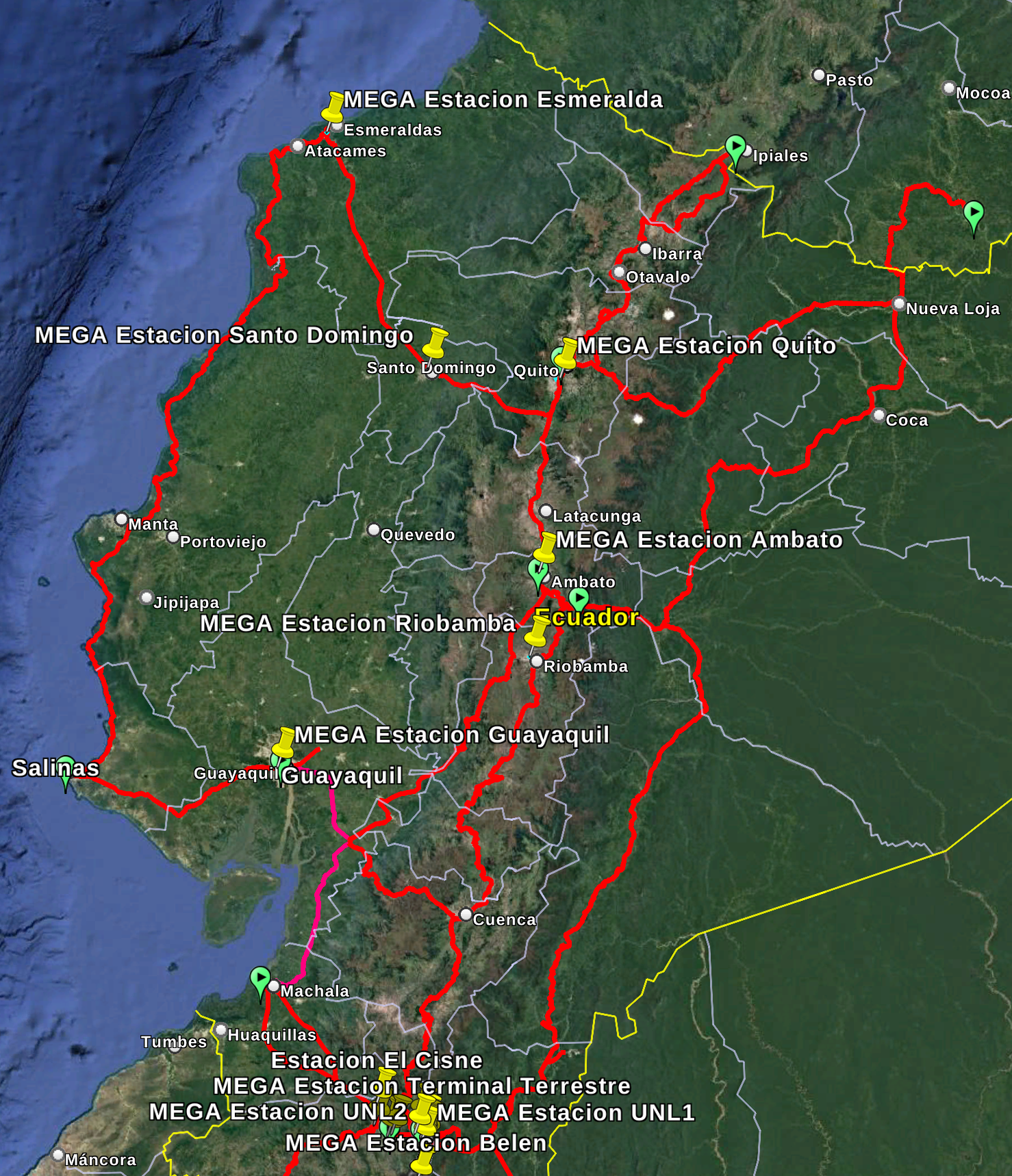
Reference map of the Celestavia network and its mega-stations across Ecuadorian territory.
Routes & costs (preliminary technical and financial studies)
Regional routes — 4,887 km total
- 1,146 km — Ruta del Sol (Quito–Santo Domingo–Esmeraldas–Salinas–Guayaquil).
- 1,200 km — Sierra Trunk Line, National (Rumichaca–Macará).
- 700 km — Coastal integration.
- 457 km — Baños–Puyo–Tena–Archidona–Nueva Loja–Puerto Asís.
- 400 km — Amazonian.
- 300 km — Central Sierra.
- 300 km — Northern Border Integration.
- 216 km — Volcanic route: secondary lines and connections (Baños–Ambato; Tena–Coca; Nueva Loja–Shushufindi).
- 108 km — Connections to urban areas, tourism/eco routes, and rural communities.
- 60 km — Southern Regional (Loja City, Catamayo Airport, El Cisne).
Celestavia infrastructure
4,887 km of route, medium and small stations, 9- and 18-passenger cabins and carriages, chassis for 10–60 ft containers, power generation, fiber optics, and 5G. Equivalent to $12,144,000 USD per km.
94 multifunctional mega-stations
Health centers/hospitals, education, agricultural collection, sports, recreation, restaurants, office, hotel, housing, museum, theater, cinema, automated warehouses, and areas for autonomous air taxis and drones.
Communities
Education, holistic health (hospitals), recreational and artistic activities, cultural heritage, tourism, and integral organic agricultural projects.
Rigorous oversight, with real-time public access to accounting and fund movements at ggtrust.com.
System benefits
Environmental
- Zero pollution: 100% electric system.
- Protection of parks: El Cajas, Sangay, Cayambe-Coca, Cotopaxi, Podocarpus, and others.
- Integrated electrical grid along the entire route.
Community
- Between 1.2 and 1.5 million direct and indirect jobs.
- Economic empowerment of women who are victims of violence (6 in 10).
- Reduction of poverty and malnutrition.
- Education, housing, reforestation, sports, and culture.
Technological
- Fiber optics and 5G coverage at every tower.
- Emergency transport: ambulance, fire, and rescue services.
- Real-time seismic and climate monitoring.
- AI video surveillance and efficient public lighting.
Economic
- Green jobs and smart collection centers.
- Coordinated agricultural production with no waste.
- Planned urban development and sustainable eco-tourism.
- Pioneers in SkyCar air taxis and drone delivery.
Celestavia’s strengths
- 3 to 10 times faster than a bus or train: no intermediate stops, 9- and 18-passenger cabins, up to 60 km/h in the city and 120 km/h in rural areas, with no accident risk.
- Available 24 hours, with fares comparable to a bus. It doesn’t invent new technology — it reuses proven technologies, many over a hundred years old.
- The cost of the entire system is lower than that of a four-lane highway.
- Seismic-resistant system, active weather monitoring, and AI-based control at every tower.
- Only two to three years to become operational, with a service life of over a hundred years.
- Ideal for connecting with the National Postal Service: every station has automated lockers and warehouses for all types of packages.
Cost–benefit–scope comparison
| Current scenario | With Celestavia |
|---|---|
| Carriers tied to agricultural, industrial, and passenger cargo. | Integrated cargo transport systems using new technology, with the option to join the system. |
| Limited State presence in agricultural zones, hindering economic development. | State presence for agro-industrial processes and natural-medicine research centers. |
| Road construction damages ecosystems and reduces biodiversity. | Strengthens eco-tourism and harmonious coexistence with nature. |
| No transport of power, internet, or social services. | With power, 5G internet, monitoring, public lighting, cameras, education, and housing. |
| Criterion | 4-lane highway | Celestavia |
|---|---|---|
| Environmental protection | No | Yes |
| Publication of progress & investment reports | No | Yes, online for auditors and citizens |
| Tolls | Yes, increasing cost of living (0.2%–1% inflation) | No tolls |
| License-plate driving restrictions | Yes | No |
| Waste collection | No | Yes, with recycling employment |
Job creation & conclusion
Financial structure
In Ecuador, the Celestavia system will be implemented through a Public-Private Alliance between the Government of Ecuador and the entity formed by Global Genius Trust USA — owner of the Celestavia technology — and FUNDA A AFI, acting as fund administrator and community intermediary.
Ecuador would contribute a 140-meter-wide strip along the route (except in urban areas) as a right-of-way for suspended-cable transport, with a high-voltage grid, fiber optics, and 5G/6G technology. Funds will come from legal sources: private entities, international social and economic development organizations, and humanitarian assistance.
In alliance with
Celestavia Co. (USA), owned by Global Genius Trust, together with FUNDA A AFI Internacional. Open to temporary partnerships with local industry, with assembly in a free-trade zone and Ecuadorian basalt and silica as the primary input.


Implementation methodology
1. Public-Private Alliance
Establishment of a PPP between the Government of Ecuador and Celestavia/FUNDA A AFI.
2. Legal framework
Creation of new legislation for integrating the Celestavia system.
3. Institutional coordination
Government coordination to accelerate permitting and administrative processes.
The project begins with the first 8 km of connection, topographic and agricultural soil analysis, and traffic data collection. It continues with testing, supplier selection, and phased construction, alongside a community-awareness campaign about participation opportunities in tourism, education, health, housing, and new agricultural and industrial ventures.
Conclusion
CELESTAVIA offers an unmatched opportunity to change how people and goods move across Ecuador, ensuring sustainability and efficiency while generating social progress and wealth. From an economic standpoint, it contributes to the National Budget surplus, promoting equity in access to opportunity and peaceful coexistence among communities. This plan will increase the value of urban and rural land along the route, contributing to GDP and the vitality of the economy.
Awaken the future today! Ecuador is ready to launch into a new era of mobility, progress, and tourism with CELESTAVIA. It’s not just a journey — it’s a green revolution.
Appendix: the food chain & integral health
One of the strategic pillars of the Celestavia system is the food chain, conceived as a complete ecosystem spanning from soil protection to human health as a whole: nutrition, health, housing, education, productive work, mobility, energy, communication, culture, and environmental balance — all interdependent parts of one living system.
Nutrition connects directly with holistic, preventive medicine services at every health center in the system, with an emphasis on prevention: proper nutrition, sports, and spaces that promote mental wellbeing. The Celestavia system was designed by Fundación FUNDAAAAFI, Global Genius Trust, and Celestavia as part of the long-term vision the Ruta del Progreso por la Equidad y la Paz.
Video
Contact
Do you represent a government, public entity, or NGO?
Request detailed technical and financial information to evaluate implementing Celestavia in your region.
Request informationThe figures in this summary correspond to preliminary technical and financial pre-studies for the Celestavia Ecuador project and are subject to definitive feasibility studies.