CELESTAVIA · Route of Progress for Equity and Peace
The aerial network driving Colombia’s future
Revolutionizing transportation: safer, faster, cleaner, and sustainably designed.
Total investment: $146,190 million USD 6,965.4 km of routes Operational in 3 yearsExecutive summary
CELESTAVIA is an integrated international multi-development system connecting transportation, agriculture, trade, tourism, health, and education across Colombian territory. It is a 100% electric, suspended-cable aerial transit system that would link the Pacific with the Atlantic and the country’s east with its west, at an estimated total cost of $146,190 million dollars.
Connects Colombia like never before
With a network of 6,965.4 kilometers of suspended aerial cable transport, CELESTAVIA integrates the country’s regions through modern infrastructure that links cities, municipalities, production centers, ports, airports, and historically isolated territories, strengthening national integration and peacebuilding.
Drives the national economy
CELESTAVIA develops multimodal infrastructure for efficient passenger and cargo transport, reducing logistics times and costs, strengthening production chains, and boosting the competitiveness of agribusiness, trade, industry, and exports.
Protects natural heritage
Operating on 100% electric power, the system minimizes land occupation and significantly reduces carbon emissions, preserving forests, páramos, jungles, rivers, wetlands, and strategic ecosystems, in harmony with sustainable development.
Generates employment and regional development
The project drives thousands of direct and indirect employment opportunities by strengthening sustainable agricultural production, industrial transformation, tourism, logistics, innovation, and infrastructure development across the national territory.
Drives sustainable tourism
CELESTAVIA connects National Natural Parks, ecological reserves, heritage towns, and high-environmental-value tourist destinations, promoting responsible tourism that protects biodiversity and generates new economic opportunities for local communities.
Promotes health and wellbeing
The macro-project strengthens healthy-food networks, organic agriculture, and integral health centers that combine conventional medicine with ancestral knowledge, contributing to the population’s physical, mental, and social wellbeing.
Transforms education for development
The initiative includes the creation and strengthening of educational institutions, technical and technological training centers, and specialized universities, preparing the human talent that will lead the country’s agribusiness, logistics, energy, and technological transformation.
Strengthens agribusiness development
In coordination with the Route of Progress for Equity and Peace of Colombia program, CELESTAVIA facilitates efficient transport of agricultural inputs and products, improves access to domestic and international markets, and promotes the industrialization of agriculture with added value.
Brings prosperity to communities
With investments exceeding USD 60,000 million, the macro-project drives comprehensive housing, health, education, infrastructure, public services, rural development, and income-generation programs, prioritizing the most vulnerable populations and promoting territorial equity.
CELESTAVIA: Smart infrastructure to connect Colombia’s future
Colombia faces major challenges in connectivity, logistics, and territorial integration that limit the economic, agribusiness, tourism, and social development of large regions of the country. In response to these challenges, CELESTAVIA is established as one of the strategic components of the Route of Progress for Equity and Peace of Colombia macro-project, through a modern national network of suspended aerial cable transport designed to integrate the territory efficiently, sustainably, and with deep respect for natural heritage.
With a projected network of 6,965.4 kilometers, CELESTAVIA will connect agribusiness production centers, cities, municipalities, sea and river ports, airports, industrial parks, logistics platforms, rural areas, and strategic corridors, strengthening national competitiveness and generating new economic and social development opportunities for millions of Colombians.
More than a transportation system, CELESTAVIA constitutes a high-impact national logistics solution that can operate independently or as strategic infrastructure supporting the Atrato–Truandó Interoceanic Canal, or other connection points, facilitating the connection between the Atlantic and Pacific oceans through multimodal corridors for passenger and cargo transport. Its modular, scalable, and prefabricated design allows the network to be developed in approximately three years, offering a rapid-implementation alternative to large conventional infrastructure projects and allowing economic and social benefits to reach the country in a considerably shorter timeframe.
Its design responds to the highest environmental sustainability standards. The infrastructure requires minimal ground intervention through support towers generally spaced every 100 meters, or greater distances where topography allows. In ecosystems of special environmental sensitivity — national parks, forest reserves, tropical rainforests, wetlands, mangroves, páramos, canyons, or major rivers — the system can span distances exceeding one kilometer between towers, avoiding direct ground intervention and allowing passage through protected areas without fragmenting ecosystems.
This technological capability preserves biodiversity, protects fauna and flora, conserves biological corridors, maintains ecological connectivity, and respects the natural flow of surface and groundwater, minimizing disturbance to biota and significantly reducing environmental impact compared to traditional roads, which require extensive earthmoving, deforestation, and permanent landscape modification.
By operating entirely on electric power, CELESTAVIA helps reduce greenhouse gas emissions, lower the transportation sector’s carbon footprint, and consolidate an infrastructure model aligned with the principles of sustainable development, climate change adaptation, and the protection of Colombia’s natural resources.
CELESTAVIA is conceived as a national multimodal transportation system fully integrated with highways, rail corridors, sea ports, river ports, airports, logistics platforms, free trade zones, and agribusiness production centers, optimizing the movement of passengers and goods, reducing logistics costs, and strengthening the country’s competitiveness in domestic and international markets.
As a structural component of the Route of Progress for Equity and Peace of Colombia macro-project, CELESTAVIA facilitates the industrialization of agriculture, strengthens food security, drives agribusiness transformation, promotes ecological tourism, boosts regional and international trade, and creates conditions for sustainable economic growth across all regions.
Its implementation represents a powerful tool for social transformation by facilitating access for millions of Colombians to health, education, housing, employment, digital connectivity, markets, culture, and investment opportunities — especially in territories historically excluded or affected by conflict. Regions such as El Plateado, Catatumbo, the Colombian Pacific, the Amazon, the Orinoquía, and other strategic zones will be able to fully integrate into national development through sustainable economic alternatives, strengthening the State’s institutional presence and promoting the consolidation of territorial peace.
CELESTAVIA also drives the creation of new development hubs around its stations, promoting agribusiness parks, logistics centers, tourism complexes, innovation centers, educational institutions, hospitals, regional markets, and new opportunities for public and private investment — generating formal employment, strengthening local economies, and improving communities’ quality of life.
With resilient, clean, efficient, and rapidly-deployable infrastructure, CELESTAVIA represents a new vision of national development: a territorial integration network capable of operating autonomously or as a complement to the Atrato–Truandó Interoceanic Canal, boosting Colombia’s competitiveness as a logistics platform between the Atlantic and Pacific oceans and consolidating a growth model based on innovation, sustainability, equity, and peace.
CELESTAVIA doesn’t just connect destinations; it connects opportunities, protects Colombia’s natural wealth, and builds strategic infrastructure for present and future generations, becoming one of the fundamental pillars of the Route of Progress for Equity and Peace of Colombia macro-project.
CELESTAVIA is not just an infrastructure project: it is an opportunity to position Colombia, among other countries, as a leader in sustainable holistic transportation and global organic agricultural trade, with an estimated return on investment of 7 to 10 years.
Specific objectives, grounded in our Criollo Ideology
What is Our Criollo Ideology? A development philosophy conceived by Juan Carlos Fuentes Cuello —founding president of FUNDA A AFI Internacional— from decades of work alongside Colombian communities and exchanges with social, economic, and political sectors across Europe and South America. It holds that equity and peace are built through the permanent generation of new wealth and equal opportunity. Read the full foundation →
Colombia faces major challenges in connectivity, logistics, and territorial integration that limit the economic, agribusiness, tourism, and social development of large regions of the country. In response to these challenges, CELESTAVIA is established as one of the strategic components of the Route of Progress for Equity and Peace of Colombia macro-project, through a modern national network of suspended aerial cable transport designed to integrate the territory efficiently, sustainably, and with deep respect for natural heritage.
With a projected network of 6,965.4 kilometers, CELESTAVIA will connect agribusiness production centers, cities, municipalities, sea and river ports, airports, industrial parks, logistics platforms, rural areas, and strategic corridors, strengthening national competitiveness and generating new economic and social development opportunities for millions of Colombians.
More than a transportation system, CELESTAVIA constitutes a high-impact national logistics solution that can operate independently or as strategic infrastructure supporting the Atrato–Truandó Interoceanic Canal, or other connection points, facilitating the connection between the Atlantic and Pacific oceans through multimodal corridors for passenger and cargo transport. Its modular, scalable, and prefabricated design allows the network to be developed in approximately three years, offering a rapid-implementation alternative to large conventional infrastructure projects and allowing economic and social benefits to reach the country in a considerably shorter timeframe.
Its design responds to the highest environmental sustainability standards. The infrastructure requires minimal ground intervention through support towers generally spaced every 100 meters, or greater distances where topography allows. In ecosystems of special environmental sensitivity — national parks, forest reserves, tropical rainforests, wetlands, mangroves, páramos, canyons, or major rivers — the system can span distances exceeding one kilometer between towers, avoiding direct ground intervention and allowing passage through protected areas without fragmenting ecosystems.
This technological capability preserves biodiversity, protects fauna and flora, conserves biological corridors, maintains ecological connectivity, and respects the natural flow of surface and groundwater, minimizing disturbance to biota and significantly reducing environmental impact compared to traditional roads, which require extensive earthmoving, deforestation, and permanent landscape modification.
By operating entirely on electric power, CELESTAVIA helps reduce greenhouse gas emissions, lower the transportation sector’s carbon footprint, and consolidate an infrastructure model aligned with the principles of sustainable development, climate change adaptation, and the protection of Colombia’s natural resources.
CELESTAVIA is conceived as a national multimodal transportation system fully integrated with highways, rail corridors, sea ports, river ports, airports, logistics platforms, free trade zones, and agribusiness production centers, optimizing the movement of passengers and goods, reducing logistics costs, and strengthening the country’s competitiveness in domestic and international markets.
As a structural component of the Route of Progress for Equity and Peace of Colombia macro-project, CELESTAVIA facilitates the industrialization of agriculture, strengthens food security, drives agribusiness transformation, promotes ecological tourism, boosts regional and international trade, and creates conditions for sustainable economic growth across all regions.
Its implementation represents a powerful tool for social transformation by facilitating access for millions of Colombians to health, education, housing, employment, digital connectivity, markets, culture, and investment opportunities — especially in territories historically excluded or affected by conflict. Regions such as El Plateado, Catatumbo, the Colombian Pacific, the Amazon, the Orinoquía, and other strategic zones will be able to fully integrate into national development through sustainable economic alternatives, strengthening the State’s institutional presence and promoting the consolidation of territorial peace.
CELESTAVIA also drives the creation of new development hubs around its stations, promoting agribusiness parks, logistics centers, tourism complexes, innovation centers, educational institutions, hospitals, regional markets, and new opportunities for public and private investment — generating formal employment, strengthening local economies, and improving communities’ quality of life.
With resilient, clean, efficient, and rapidly-deployable infrastructure, CELESTAVIA represents a new vision of national development: a territorial integration network capable of operating autonomously or as a complement to the Atrato–Truandó Interoceanic Canal, boosting Colombia’s competitiveness as a logistics platform between the Atlantic and Pacific oceans and consolidating a growth model based on innovation, sustainability, equity, and peace.
CELESTAVIA doesn’t just connect destinations; it connects opportunities, protects Colombia’s natural wealth, and builds strategic infrastructure for present and future generations, becoming one of the fundamental pillars of the Route of Progress for Equity and Peace of Colombia macro-project.
Specific objectives
- An ecological, sustainable transportation model with minimal environmental impact.
- Position Colombia, among other countries, as a leader in the global organic and agribusiness market.
- Pioneers of Celestavia technology on the American continent.
- 90% use of Colombian basalt in materials.
- Contribution to victim reparations alongside UARIV (9 million people).
- Agricultural Marketing Centers in 100% of provinces.
Interoceanic Canal
From the Panama Canal to the Colombia and Latin America 2050 Vision
Celestavia as a strategic solution for global transportation, inspired by our Criollo Ideology.
Colombia and Latin America 2050 Vision
Colombia and Latin America hold a historic opportunity to establish themselves as the new strategic axis of world trade. Our privileged geographic location, the richness of our natural resources, human talent, and capacity for innovation allow us to envision a development path that transcends the traditional role of raw-material suppliers and positions us as leaders in infrastructure, technology, and global logistics.
It is in this context that Celestavia emerges — an initiative conceived under the principles of Our Criollo Ideology, understood as a development philosophy based on technological sovereignty, innovation rooted in our own knowledge, sustainable industrialization, regional integration, and the generation of wellbeing for present and future generations.
More than 80% of world trade moves by sea. The sustained growth of the international economy demands increasingly efficient, resilient, and sustainable logistics solutions. Celestavia responds to this challenge through an intelligent, automated, high-capacity land corridor designed to complement major international shipping routes and strengthen the continuity of global trade.
The system is projected to move between 35,000 and 150,000 TEU daily, including dry cargo containers, refrigerated cargo, liquefied natural gas (LNG), fuels, and strategic goods, through an automated, continuous-operation model, at an estimated cost of approximately USD 85 per TEU — offering a highly competitive logistics alternative for international trade.
Celestavia represents far more than an infrastructure project. It constitutes a new development paradigm for Colombia and Latin America, where engineering, artificial intelligence, automation, clean energy, and technological innovation converge to build a logistics system ready for the demands of the 21st century.
Our Criollo Ideology: five strategic pillars
- Technological and scientific sovereignty.
- Industrialization with high added value.
- Logistics integration between the Atlantic, the Pacific, and the main international markets.
- Inclusive economic development with job creation, knowledge, and shared prosperity.
- Environmental sustainability through smart infrastructure, clean energy, and low-emission technologies.
The Colombia and Latin America 2050 Vision proposes turning the region into the leading logistics, energy, and industrial platform of the Western Hemisphere through the integration of multimodal corridors, smart ports, rail systems, digital platforms, industrial zones, innovation centers, and automated transportation solutions.
Celestavia is one of the strategic projects within this vision, strengthening connectivity between the Atlantic and Pacific oceans and facilitating Latin America’s integration with Asia, North America, Europe, Africa, and the emerging Indo-Pacific markets.
This vision does not seek to replace existing infrastructure, but rather to expand global logistics capacity through complementary solutions that increase the resilience of global supply chains, reduce response times in contingencies, and promote more efficient, secure, and sustainable international trade.
By 2050, Colombia and Latin America can establish themselves as a world center of logistics innovation, smart infrastructure, and technological development — exporting not just goods and natural resources, but also knowledge, engineering, technology, and comprehensive solutions for global transportation.
Celestavia symbolizes that aspiration: an initiative born from Our Criollo Ideology that projects Colombia and Latin America as protagonists of a new stage of global development — grounded in cooperation, innovation, sustainability, and the ability to deliver strategic solutions for the future of international trade.
System scope in Colombia
Colombia: The natural axis of global logistics integration
Colombia is one of the few nations in the world with direct access to both the Atlantic and Pacific oceans, a privileged location at the center of the American continent, and one of the planet’s greatest biodiversities. These geographic and environmental advantages, combined with its strategic position between North and South America, make the country the ideal setting to lead a new generation of infrastructure for international trade.
Under the vision of Our Criollo Ideology, Celestavia proposes transforming these natural advantages into a platform for economic, technological, and logistics development of global reach. The system forms a great national integration corridor linking the country’s main borders, productive regions, industrial centers, agricultural zones, sea ports, and foreign-trade platforms, strengthening Colombia’s competitiveness and its connection with Latin America.
Celestavia’s strategic network integrates the northern extreme at Paraguachón and Maicao (La Guajira) with the southern extreme at Rumichaca, the border with Ecuador; and the eastern extreme at Puerto Carreño (Vichada) with the western extreme at Buenaventura (Valle del Cauca), linking the Orinoquía, the Altillanura, the Andean region, the Caribbean, and the Colombian Pacific through an automated, high-capacity transportation system.
This national integration facilitates efficient connections among the main sea ports, airports, free trade zones, industrial parks, logistics centers, energy corridors, and tourist hubs, consolidating a network that strengthens both domestic trade and international supply chains.
Within the framework of the Colombia and Latin America 2050 Vision, Celestavia projects Colombia as the primary logistics bridge of the Western Hemisphere, connecting South American markets with Central America, North America, Europe, Asia, and the Indo-Pacific region through smart infrastructure, automation, artificial intelligence, and sustainable solutions for global transportation.
More than a national corridor, Celestavia constitutes a strategic platform for continental integration, conceived to drive regional development, facilitate trade, attract international investment, generate high-value-added employment, and position Colombia as a world center for logistics innovation and smart transportation, inspired by the principles of Our Criollo Ideology.
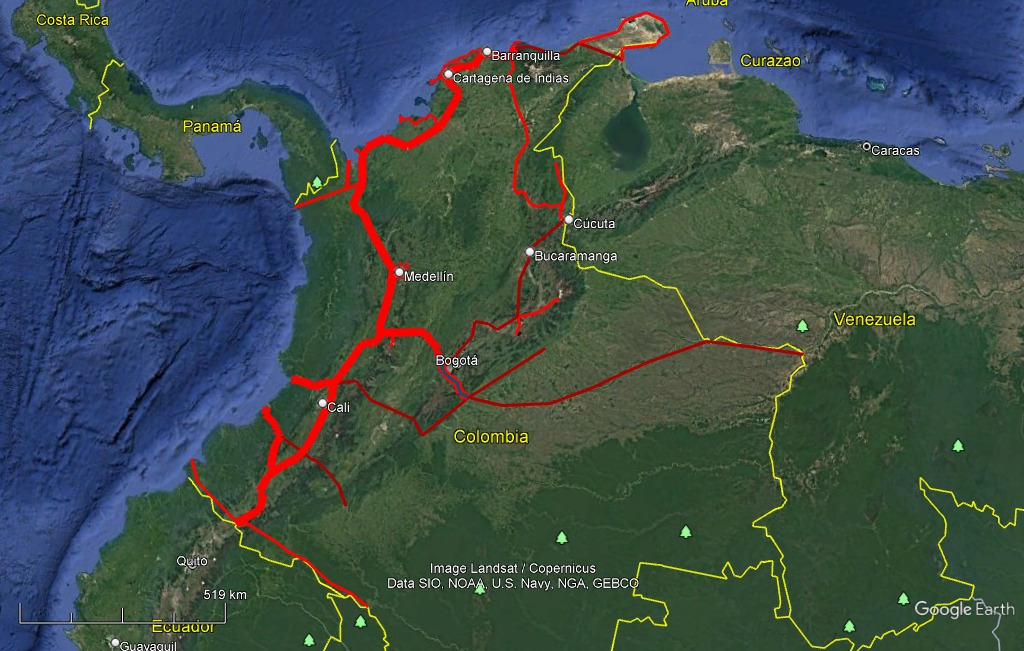
Reference map of the Celestavia interregional network across Colombian territory.
Regional interconnection corridors — 5,976.4 km
- 1,971 km — Southwestern pan-American trunk route “Route of Progress” (Rumichaca to Guajira, border with Venezuela), including the Riohacha secondary route and a branch to El Dorado Airport.
- 1,216 km — Orinoquía Route (Puerto Carreño to Punta Soldado, Buenaventura).
- 216 km — Southern Orinoquía Route (Florencia, Caquetá to Puerto López de Micay), including construction of an airport under the direction of the YAMBITARA Foundation —chaired by Dr. Jaime Morales— with integrated projects of similar and special characteristics benefiting the region.
- 470 km — Orinoquía-to-Atlantic Route (Yopal to Las Pavas, Manizales).
- 1,090 km — Los Comuneros to the Sea Route (Mosquera to Ciénaga, with a Catatumbo branch).
- 182 km — Micay Route (El Estrecho, Cauca to Puerto López de Micay).
- 52.3 km — Aburrá Valley Route, Antioquia.
- 525 km — Pacific Route (Tumaco to Puerto Leguízamo, connecting to the Amazon).
- 253 km — 8-way interoceanic route (Urabá, Antioquia).
Tourist routes — 989 km
- 396 km — Cabo de la Vela Route (Guajira).
- 49.2 km — El Rodadero Route, Santa Marta (Magdalena).
- 176 km — Coastal Highway Route (Barranquilla–Cartagena).
- 148 km — Morrosquillo Gulf Route (Sucre–Córdoba).
- 99.5 km — Nevado del Cocuy Route (Boyacá).
- 54.5 km — Laguna de Tota Route (Boyacá).
- 32.9 km — Nevado del Ruiz Route (Manizales).
- 33.3 km — Peñol de Guatapé Route.
Complementary tourist routes, including connections to National Natural Parks available at parquesnacionales.gov.co.
Estimated investment (technical and financial pre-studies)
Celestavia infrastructure
6,965 km of route, 630 medium stations, and 12,390 small stations (excluding land and mega-stations). Equivalent to $10,345,571 USD per km.
136 multifunctional mega-stations
Electricity generation and transmission, fiber optics and 5G, cargo and passengers, AI video surveillance, mobile reserves, two sea ports, automated warehouses, and a maintenance fleet. They will feature leasable spaces for medical and general-therapy clinics, supermarkets, clothing stores, public-service and government offices, and recreational spaces such as cinemas, children’s arcades, and conference rooms, among others — never casinos or bars.
Communities
Education, holistic integral health, culture, organic agricultural development, housing, agronomy, tourism, and power generation, delivered to communities, micro and mid-sized businesses, and supporting agricultural industries with a subsidized rate of up to 30% (a percentage to be negotiated with large companies, in exchange for hiring skilled labor from the benefiting territories). All with a focus on vulnerable populations, ZOMAC and PDET municipalities, as well as the most remote populations with low State presence, seeking equity and equal opportunity. With the backing of governments, we seek healthy coexistence and for the Route of Progress for Equity and Peace of Colombia to become a reality and a pilot model to replicate in other countries.
System benefits
Environmental
- Zero emissions: 100% electric system.
- Protection of parks, páramos, and nature reserves: Darién, Paramillo, Los Katíos, Tayrona, Nukak Reserve, among other protected areas of the country.
- Sustainable use of coastal zones for agrotourism and ecotourism.
- Integrated electrical grid along the entire route.
Economic
- Green employment in local communities.
- Boost to agribusiness production.
- Smart Collection Centers and planned urban development.
- Sustainable tourism with minimal impact.
Technological
- Fiber optics and 5G coverage at every tower.
- Emergency transport: ambulances, firefighters, and rescue.
- Seismic and climate monitoring.
- Real-time AI video surveillance.
Social
- Empowerment of women who are victims of violence (51%).
- Reduction of poverty and malnutrition.
- Education, housing, culture, sports, and community health.
- Effective State presence in remote areas.
Comparison against a 4-lane highway
| Criterion | 4-lane highway | Celestavia |
|---|---|---|
| Environmental protection | No | Yes |
| Publication of progress and investment reports | No | Yes, periodic reports published online, open to citizen oversight |
| Tolls | Yes, increasing cost of living (0.2%–1% inflation) | No tolls |
| Vehicle circulation restrictions | Yes | No |
| Waste collection | No | Yes, with job creation in recycling |
Job creation
Financial structure and public-private alliance
Celestavia’s rollout in Colombia is structured through a Public-Private Alliance (APP) between the Government of Colombia and the entity formed by Global Genius Trust USA —owner of the Celestavia technology— and Funda A AFI, in its role as fund administrator and community intermediary.
The concession is structured over a 140-meter-wide transportation easement along the route (except in urban areas), for suspended cables, a high-voltage electrical grid, fiber optics, and 5G/6G technology, without affecting the natural environment except at specific tower, station, and commercial-center locations. The economic proposal will define the participation of the Central Government, financiers, transportation associations, and consortiums, with funds of legal origin from private entities and international social and economic development organizations.
In alliance with
Celestavia Co. (USA), owned by Global Genius Trust, together with Funda A AFI Internacional. Open to temporary partnerships with Colombian industry and companies, with assembly in the country’s free trade zones and Colombian basalt as the primary input.


Implementation methodology
1. Public-Private Alliance
Formalization of the APP between the Government and Celestavia/Funda A AFI.
2. Legal framework
Creation of the legislation required to integrate the system.
3. Institutional coordination
Coordination with national, local, and territorial authorities to accelerate permits and processes, through working sessions in each benefiting community.
In technical terms, the project begins with the first 8 km of connection, topographic and soil studies, and traffic modeling, followed by testing, supplier selection, and phased construction. Private tenders will be held to select domestic companies, including temporary joint ventures, and foreign companies where the necessary capabilities do not exist within the country. In parallel, an awareness campaign and socioeconomic stratification will move forward to identify community opportunities for participation in tourism, education, health, housing, and new agricultural and industrial businesses.
Conclusion
CELESTAVIA guarantees comprehensive connectivity at every point: passenger and cargo transport, fiber-optic internet, and 5G/6G coverage. With this, it offers an opportunity to transform the movement of people and goods in Colombia with sustainability, environmental respect, efficiency, and social progress — positioning Colombia, among other countries, as a world pioneer in sustainable mobility and international trade. The project contributes to the surplus of municipalities, departments, and territorial authorities, to the appreciation of urban and rural properties along the route, and to peaceful coexistence among communities, benefiting Indigenous, Raizal, and Afro-descendant populations, as well as all social strata of the national territory, laying the foundation for the generation of new wealth.
Contact
Global Genius Trust USA · Celestavia USA
www.celestavia.com www.grupogenio.comDo you represent a government, public entity, or NGO?
Request detailed technical and financial information to evaluate Celestavia’s implementation in your region.
Request InformationThe figures in this summary correspond to preliminary technical and financial pre-studies for the Celestavia Colombia project and are subject to final feasibility studies.